
This is a grenade of a book. Based on extensive investigative reporting on both sides of the U.S.-Mexico border, Sam Quinones’ Dreamland tells the deeply unsettling story of the production, smuggling, and marketing of semi-processed opium base— or “black tar heroin”— originating in and around Xalisco, a farm town in the state of Nayarit, and in tandem, the story of the aggressive marketing of pain pills in the U.S.— in particular, of Purdue Pharma’s OxyContin—and the resulting conflagration of addiction and death. [CONTINUE READING MY REVIEW FOR LITERAL]

#2. The Discovery of Middle Earth: Mapping the Lost World of the Celts By Graham Robb
A book as surprising as finding, say, a live orca in one's bathtub (well, assuming you have a jumbo tub). Merits a re-read or five.
#3. Our Land Before We Die: The Proud Story of the Seminole Negro By Jeff Guinn
A strange, tragic, and expertly told story. I am powerfully grateful that Miss Charles and Mr Warrior and other members of the Seminole Negro community in Bracketville, Texas so generously shared their story with Jeff Guinn and that he, in turn, took the trouble to research and write such a fine book. Deservedly, Our Land Before We Die won the Texas Book Award after it was first published in 2002. (And thanks, Augusta Pines and Windy Goodloe of the Seminole Negro Indian Scout Cemetery Association for the recommendation. I'll have much more to say about this book and the Seminole Negro Scouts in my book about Far West Texas. Stay tuned.)

#4. West of the Revolution: An Uncommon History of 1776 By Claudio Saunt
Mind-soaringly wizardrous!(UPDATE: I finally got around to writing a proper review of this in 2018. You can read the review here. )
#5. Walking through Walls: A Memoir By Philip Smith
Now that my own book, Metaphysical Odyssey into the Mexican Revolution, is out in the world and on its own way, I haven't been delving into metaphysical literature so intensively as before. I miss the way-out wigginess of it— and I know, it's not for everyone. But in a way, it's a relief to have moved on because usually, in terms of literary quality, metaphysical literature can be cloggy sloggin'. So this elegant and sensitively told memoir of growing up as the son of a decorator-turned-psychic healer in Florida— oh, yeah, it's wiggy— was an especially scrumptious read.

Nothing has helped me understand Texas more than this book. Ditto my family's roots in "Yankeedom," "New Netherland," and "The Left Coast."
 # 7. The Edge of the World : A Cultural History of the North Sea and the Transformation of Europe By Michael Pye
This completely changed how I think about Europe, and especially the Vikings and the Irish and international trade. Sad about what happened to the codfish.
#8. Tie
J. Frank Dobie: A Liberated Mind by Steven L. Davis
A superb biography about the 20th century's bard of Texas.
Lynching Pascual Orozco: Mexican Revolutionary Hero and Paradox by Raymond Caballero
This is the first major biography in over 40 years of one of the most important figures of the Mexican Revolution. Caballero is also the ex-mayor of El Paso, Texas and, in his words "a recovering lawyer"— a background that no doubt helped him unravel the conspiracy he found revealed in the one hundred year-old records of the Culberson County Courthouse, apparently intended to cover up what really happened to Pascual Orozco and his men in the High Lonesome Mountains south of Van Horn in 1915. Caballero's Lynching Pascual Orozco is an important contribution to the history of not only the Mexican Revolution, but of the state of Chihuahua and of Far West Texas.

> Listen to my super crunchy podcast interview with Raymond Caballero for the Marfa Mondays Podcasting Project here.
#9. The Pecan: A History of America's Native Nut by James McWilliams
Crisply entertaining and chock-full of crunchy research by a food historian, this apparently delicious little book on America's native nut— (and isn't the cover charming?)— is a horror story. [CONTINUE READING MY REVIEW]
#10. Tie
Love, Alba By Sophy Burnham
[My writing assistant, Washingtoniana, not sure about cats]

An audacious literary achievement in the tradition of Watership Down and Timbuktu, Sophy Burnham's Love, Alba takes a Washingtonian cat's eye view of love, betrayal, high society, and art theft that is at once charming and deeply wise.
The Art of Asking By Amanda Palmer
This is a 1,000 candle review, but I should start by saying I am the last person who would attend an Amanda Palmer concert because I don't like loud, I don't like crowds, and especially feisty crowds, and most things explicit make my toes curl. As far as music goes, I'm more an opera-at-the-Kennedy-Center kind of person (and that would include some fairly way-out opera, by the way). I have zip to do with the music business; I write literary fiction, poetry, and essay. But Amanda Palmer, you're a hero to me because you're an artist as shaman, and that's what it's all about, and in The Art of Asking, you explain this beautifully and with bodacious heart. For both myself and my writing students, I maintain a list of recommended books on process. I'm a voracious reader but it has been a long Gobi Desert of a time since I've read anything to add to this list. Today, with a big fat star, I add The Art of Asking. And not because the book is about asking— and "taking the donuts," as Palmer puts it— indeed, something for which most writers, and especially women writers, need some coaching— but because what it's really about is the meaning and the reality of being a true artist. That the true artist is a kind of shaman— we forget this in the noise, shiny plastic, and conformity of industrial culture. Remembering it is a profound gift.

>Watch Amada Palmer singing the "Ukelele Anthem" and giving her famous TED talk.
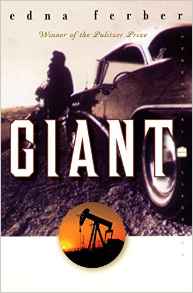
Giant by Edna Ferber
Of course I'd already seen the 1956 movie starring Rock Hudson, Elizabeth Taylor, and James Dean. Finally, I got around to reading the novel. It struck me as a Texan (cattle vs oil) version of War and Peace, gorgeous and even transcendent in places, yet glaringly flawed in others. I do believe that Tolstoy himself would applaud the effort and verve of this giant of a book.
> Julie Gilbert wrote an unusually structured but engaging biography of her aunt, the once white-hot famous novelist: Ferber: Edna Ferber and Her Circle.
> Listen to a recording of Edna Ferber giving a talk: "We All Sag in the Middle: The Delightfully Indignant Edna Ferber"
> Your comments are always welcome. Write to me here.

... the list goes back to 2006...
Book review by C.M. Mayo:
Book review by C.M. Mayo:
Book review by C.M. Mayo:


