 |
[ The Texas Bibliothek, Ready to Ship.
Yes, it is big. Yes, I devour books like a ravenous owl.
Yes, this is my process.
I accumulated similar-sized working libraries
in writing some of my other books, e.g.,
Miraculous Air: Journey of a Thousand Miles through Baja California (2002);
The Last Prince of the Mexican Empire (2009); and
Metaphysical Odyssey into the Mexican Revolution (2014). ] |
File this post under Future Reminder to Take My Own Advice, and if some or all of these ideas also work for you, gentle reader, verily I say unto you:
Wunderbar!
[>>
CONTINUE READING THIS POST AT WWW.MADAM-MAYO.COM]
Late last September, having finally rearranged and set up my working library in my new office in Mexico City-- the work in question being
a book on Far West Texas-- I had to pack it all back up
again and ship it across the Atlantic. (Why? Well, that's a novel I'm not going to write, both literally and figuratively).
Now that I've got my Texas books resettled on their second set of new shelves in less than six months, I'm ready to take on 2018! But whew, I've got
biceps after this job for a Hercules. The thirty-eight boxes of books comprising what I now call the Texas Bibliothek-- I have landed in German-speaking Switzerland-- arrived in mid-January. And a couple weeks later, every tome and paperback and pamphlet and back-issue of
Cenizo Journal is in place, and I can carry my bike over head! I could scoop up and toss dessicated Christmas trees, small donkeys and their
Schmutzlis out windows, too, should I take a notion!
ON ORGANIZING (AND TWICE MOVING) A WORKING LIBRARY:
Ten Lessons Learned of Late with the Texas Bibliothek
1. Organize the books by topic-- not as a librarian would recommend, but as your working writer's mind finds most apt.
After all, you're the one who will be using these books, not the general public. And even in a fairly substantial working library, such as this one, there are not enough books to justify the bothernation of cataloging and labeling each and every title.
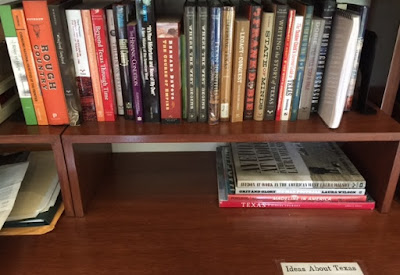 |
| [ Ideas About Texas (some, anyway)] |
If you have more than 50 books and if you do not organize them in some reasonably reasonable way, why don't you just open your front door and let your dogs wander out and then you can go looking for them on the freeway at four a.m., that might be more fun!
2. If any category has more than 30-40 books, create a new subcategory.
Because trying to keep books in alphabetic order, whether by author or by title, makes me feel dehydrated, RRRRRR.
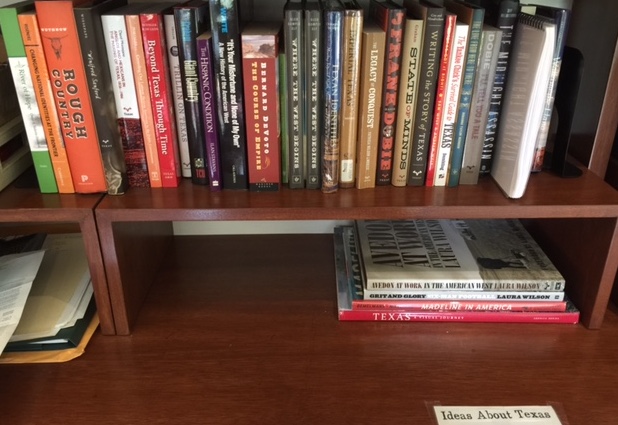
3. Label categories of books with large, easy-to-read lettering.
Because if you're a working writer, like me you're probably near-sighted...

Funny how book designers always have such unique ideas about colors and font sizes and typefaces.... In other words, I don't want to have to look at the visual clutter of those spines to try to figure out what this bunch is about; I let that
BIG FAT LABEL tell me.
If you do not want to make labels, why don't you peel the labels off all the jars and cans in your pantry, mix 'em up, and then try to find which one is the dog food and which one the canned pumpkin? That would be a mile more hilarious.
4. When moving, before touching anything, take photos of the whole shebang.
I do not have early onset dementia, but boy howdy, moving house sometimes makes me feel as if I do. (Did I used to have a working library? Was I working on a book? What day is it? Is Ikea still open?)
5. Then, before even touching those books, take a tape measure and write down the inches of shelf space required for each and every category.
 |
[ I suspect that these things are in cahoots
with pens and umbrellas. ] |
A tape measure!
I realize this may sound very OCD.
But three moves ago, it did not occur to me to do this with my working collection on Mexico's Second Empire / French Intervention, for my then recently-published book,
The Last Prince of the Mexican Empire. In the rush of moving I allowed the moving company crew to pack the books, willynilly-fefifo-rama-chillydilly, and then, on arrival, lacking space, never mind bookshelf space, and so having to leave that particular library in a half-unpacked, unsorted chaos, for the next few years more
correspondence and related research was bottlenecked than I want to think about. (That library now has its home in Mexico City-- that would be another blog post.)
The main thing is, you want to be certain you actually have the bookshelf space you need
plus ample wiggle room for each category
before you start packing-- and then double check the available bookshelf space again
before you start unpacking.
And never,
ever let anyone else pack them.
Sounds obvious. Alas, for me, three moves ago, it was not.
 |
| [ Yeah, Literary Nuns! (Note label in upper right corner) ] |
 |
[ Geology, Energy, Box 1
corresponded to category 40,
requiring 17 inches of shelf space. ] |
6. Save those neatly made shelf labels to reattach to the new shelves, and also label-- with mammoth, easy-to-read fonts-- each and every box.
7. Number each box, e.g., 1 of 32; 2 of 32, etc.
These can be cross-referenced with the master list of categories, which has the measurements.
8. Don't be stingy with boxes!!
For moving books I prefer the so-called
banker's boxes with punch-out holes for handles. Banker's boxes are large enough to take a heaping helping of books, and the handles make them easy to carry, however the weight of a book-filled banker's box remains within the range of what I, a 50-something female whose daily mainly workout consists of walking two pugs, and, la-de-da, whatever biking and yoga, can easily haul up or down a staircase.
Yes, you could snag a batch of free boxes at the grocery store, and yes, you probably could, as I certainly could, lift bigger boxes with double the number of books in them-- and most men can haul a stack of two or even three bigger boxes at a time. However, whatever the upper-body strength you have and shape you are in, when you are moving house, unless you for some reason enjoy showering hundreds of dollars on, say, your chiropractor's vacation home, lifting huge, ultra-heavy, and unwieldy boxes is penny wise and dollar dumb. Ox dumb.
Goodie for me, I learned this lesson three moves ago, and I had an excellent chiropractor.
9. Take photos of the boxes, labels included.
Because you never know! Seems I have good moving juju. Knock on wood for next time!
10. On reshelving day, gather together before commencing:
+ Papertowels
+ Cleaning spray for the shelves (they will be dusty)
+ Garbage bag
+ Tape
+ Scissors (to trim off old bits of tape, etc.)
+ Measuring tape!!!!!!!!!!
+ Step stool or small ladder
+ Water and snack
+ iPad with audiobooks and/or podcasts and/or dance music
P.S. History nerds podcast alert! Check out Liz Covart's Ben Franklin's World.
If you are missing any one of these items, you will probably have to interrupt whatever you are doing to go get it, and then in, say, the kitchen, because you have Moving on the Brain, you will be distracted by some zombie command from the dusty ethers such as,
I must now go to Ikea to buy garbage bags and whatnotsy whatnots...
+ + + + + + + +
Meanwhile, dagnabbit, people just won't stop writing books on Texas!! Two more, post-move, essential additions to the Texas Bibliothek:
Regular Army O! Soldiering on the Western Frontier, 1861-1891
By Douglas C. McChristian
The Earth is Weeping: The Epic Story of the Indian Wars for the American West
by Peter Cozzens
+ + + + + + + +
Wish me luck, gentle reader. I aim to finish my book on Far West Texas this year. By the way, I host an associated 24 podcast series, "Marfa Mondays," which is woefully behind schedule because of these moves, but soon to resume. I invite you to
listen in anytime to the 20 podcasts posted so far.
P.S. Using the free blogger platform, I also maintain an
online working library of out-of-copyright (now in the public domain, mainly linked to archive.org) Texas books-- books which I could not or did not want to attempt to purchase but would like to be able to consult at my leisure. It includes a number of titles that might appear bizarrely out of place (one is on Massachusetts, for example)-- but after all, this is not for the general public, but a working library in service of my book in-progress. I mention this because perhaps you might find it of use to create such an online library for your own purposes.
P.P.S. For those wondering, what is my take on ebooks? First of all, I
delightedly sell them! And yes, I have bought some, and as far as the Texas book research goes, when I need a book urgently and/or the paper edition is unavailable or expensive, I have been known to download a Kindle or four-- or, as above-mentioned, download out-of-copyright books for free from
www.archive.org and similar sites. I appreciate that convenience, and also the ease with which I can search within a text for a word or phrase. Nonetheless, on balance, I find ebooks decidedly inferior to paper. Morever, I doubt that my electronic libraries will outlive me in any meaningful way, while I expect that my working libraries of hardcovers and paperbacks, including
some rare editions, may serve other researchers well beyond the horizon of my lifetime.
> Your comments are always welcome.
Write to me here.
+ + + + + + + +
As anounced in
the last post of 2017, in 2018 I will be posting on Mondays on the following schedule:
First and third Mondays of the month: New writing / news / podcasts;
Second Monday: For the writing workshop;
Fourth Monday: Cyberflanerie and/or Q & A with another writer, poet, and/or translator;
Fifth Monday, when applicable: Whatever strikes my gong.


 Funny how book designers always have such unique ideas about colors and font sizes and typefaces.... In other words, I don't want to have to look at the visual clutter of those spines to try to figure out what this bunch is about; I let that BIG FAT LABEL tell me.


