Showing posts with label Madam Mayo guest bloggers. Show all posts

Wednesday, September 24, 2014

Guest-Blogger Short Story Maestro Clifford Garstang on 5 Favorite Novels About a Dangerous World

Clifford Garstang is the author of In an Uncharted Country and What the Zhang Boys Know (Winner of the 2013 Library of Virginia Award for Fiction) and Editor of Everywhere Stories: Short Fiction from a Small Planet, an anthology of 20 stories set in 20 countries by 20 well-travelled writers. Here's the description:
"Assembled from over six hundred submissions, this collection reminds us that our world is dangerous: a man disappears in Argentina, despair reigns in post-Katrina New Orleans, teen bandits attack in Costa Rica, wild boars swarm in a German forest, biker gangs battle in New Zealand, security guards overreact in Beijing, rogue militias run wild in Africa, and more. These are not ordinary travel stories by or about tourists; the contributors are award-winning authors who know their way around—former Peace Corps Volunteers, international aid workers, expatriates—and dig deep beneath the surface. "


>>CONTINUE READING THIS POST AT WWW.MADAM-MAYO.COM

FIVE FAVORITE NOVELS ABOUT A DANGEROUS WORLD
by Clifford Garstang
Some of my favorite American writers create dark stories set abroad. That’s what I like to read and it inevitably informs my own writing and my selections for the book. Here are 5 of the best:
1. Ann Patchett’s State of Wonder: I also liked Patchett’s earlier novel set in South America, Bel Canto, but this book, set in Brazil, really grabbed me—it has mystery, a heroic structure, and explores fascinating, credible science. One researcher has gone missing and another goes searching for him in the heart of darkness—classic. 
2. Russell Banks’s The Darling: Set in Liberia, Banks’s novel (which is said to be based loosely on The Tempest) explores failures of both American and Liberian governments. A former member of the Weather Underground faces exposure back home, but also faces a near-constant civil war in her adopted home.
3. Barbara Kingsolver’s The Lacuna: Kingsolver’s agenda-driven fiction isn’t for everyone, but I was drawn to this novel, set mostly in Mexico. Having grown close to Frida Kahlo and Diego Rivera in Mexico City, the protagonist settles in the U.S. and attracts the scrutiny of the Joseph McCarthy’s House Un-American Activities Committees.
4. Robert Stone’s Damascus Gate: This is a sprawling book that explores the history of Israel and the forces that would destroy it. The book is a fascinating look at one of the Middle East’s most dangerous flashpoints.
5. Tim O’Brien’s The Things They Carried . Like O’Brien’s fantastic Going After Cacciato, which won the National Book Award, The Things They Carried explores the horror of the Vietnam War and the intense personal toll it takes on all. 


===> COMMENTS always welcome and you are also most welcome to sign up for my newsletter.


Recent Madam Mayo guest-blogs include:

SURF ON over at the home page, www.cmmayo.com

Wednesday, May 29, 2013

Guest-blogger Victoria Wilcox with 5 Sites for Scarlett Fans


Victoria Wilcox
I am delighted to host guest-blogger Victoria Wilcox who has just published what promises to be a fascinating read, a novel based on the true story of Doc Holliday-- one wild dentist, I'll say. Usually we think of Doc out west, slinging a gun, but he hailed from the Old South and had some surprising connections there, as Wilcox explains. And she ought to know: not only did she write the novel about him, but she is founding director of Georgia’s Holliday-Dorsey-Fife House Museum, the antebellum home of the family of Doc Holliday. It was her work with the house that led to eighteen years of original research and inspired her novel trilogy, Southern Son: The Saga of Doc Holliday. Inheritance, the first book in the Southern Son saga was published this month by Knox Robinson Publishing. 

Ghosts of Gone With the Wind: 5 Sites for Scarlett Fans
Who would have guessed, when I moved to Georgia hoping to find a few ghosts of Gone With the Wind, that my life would be forever haunted by Margaret Mitchell’s bestselling novel of the Old South?  I was just a fan like any other, having read the book a few times and watched the movie a few times more, the only exception between me and other fans being an interesting calendar connection: I was born on Margaret Mitchell’s birthday, November the 8th.   But when my love of history and a project to save a Gone With the Wind style historic site led to my novel trilogy, Southern Son: The Saga of Doc Holliday, the epic story of the South’s most famous Western legend, our shared birthday began to seem downright spooky – November 8th was also the date that Doc Holliday died.  
The historic site was the Holliday-Dorsey-Fife House, the antebellum home of Doc Holliday’s cousins in Fayetteville, Georgia, a classic white-columned Southern mansion where Doc played as a child, and where he began a young romance with his cousin Mattie Holliday, the girl who would become the model for Melanie in Gone With the Wind.  The Hollidays were kin to Margaret Mitchell, and she was said to have visited the house and suggested it as a filming site for the movie version of Tara.  The place is even mentioned in the first chapter of Gone With the Wind, as Scarlett O’Hara attended the Fayetteville Academy, a private school once housed there.  
While Scarlett was fictional, however, there was a real Southern belle who really went to the school and had a lot in common with Scarlett: they both lived on big cotton plantations in neighboring Clayton County, they both had feisty Irish fathers named Gerald, they both had genteel mothers who had green velvet drapes in their parlor windows, they both went to Atlanta during the Civil War and survived with a little bit of grace and a whole lot of “gumption.”  The real girl was Annie FitzGerald, and she was Margaret Mitchell’s grandmother.  
It’s no wonder Gone With the Wind seems so real to its readers.  There was a lot of truth behind its story of the Old South, and a better-than-fiction link to the Wild, Wild West.  These ghosts have a great story to tell!      
For more real tales of Gone With the Wind, check out the following five sites:
The Margaret Mitchell House Museum, the Atlanta apartment when the author typed her epic tale.
Scarlett O’Hara’s Atlanta, an interactive map that takes you into the 1860’s city.
Gone With the Wind Scrapbook, a fun collection of all things Scarlett.
Gone With the Wind Online Exhibit, movie memorabilia from the David O. Selznik collection at the Harry Ransom Center, University of Texas at Austin.
Gone With the Wind Background from the AMC Filmsite Movie Review, gives a complete synopsis of the movie for who haven’t watched it but want to sound like they have.


+ + + + + + + + + + + + + +
>Recent guest-blogs include Joanna Hershon with 5 links from A Dual Inheritance that Traverse the Globe and Amy Kwei with 5 recommended books on China.

>Click here for the complete archive of Madam Mayo's guest-blogs.


Wednesday, April 27, 2011

Daniel A. Olivas: 5 Books for the Writing of the The Book of Want

It's guest-blogger Wednesday here at Madam Mayo, with Los Angeles-based novelist Daniel Olivas, who has just published a first novel-- though not his first book :The Book of Want (University of Arizona Press). It has been garnering some glowing praise, e.g., from Los Angeles Magazine: "Olivas’s brand of magical realism has a sense of humor about itself, and he succeeds in harnessing the genre’s unique ability to expose what’s beneath the surface"; from Dark Sky Magazine: "Carefully crafted and provocative, The Book of Want is nothing less than a celebration of human desire in all its forms."

I am also honored to have Daniel Olivas again as a guest-blogger because, as a blogger for La Bloga, he was one of my earliest inspirations for Madam Mayo (though it took me a while to appreciate the wisdom of blogging on Mondays, as Daniel does). I plunged into blogging in March of 2006-- ancient history now-- when the form was still so gelatinous and translucent... ayyy, let me put that in plain English: I had no idea what I was doing. Sometimes I think I still don't, that we bloggers are inventing the form as we go. Certainly, to an extent, that is true of any literary genre, including the novel, though we look to those who have tread some ground before us.

On that note, over to you, Daniel!

5 Books I Relied Upon in Writing My New Novel, The Book of Want
By Daniel Olivas


My sixth book of fiction, The Book of Want, is also my first novel (after publishing three short-story collections, a novella and a children’s picture book). As with my previous books, the City of Los Angeles plays a feature role in the novel. This is not surprising because I was born in Los Angeles and have lived here ever since, except for four years when I was a Stanford undergraduate. Because of that, I can reach back to my own history, as well as that of my parents, to paint a portrait of the city that is not a cardboard cutout.

This doesn’t mean, however, that I don’t do research. I think it’s only fair to the reader that I attempt to be as accurate as possible if I mention a particular church or school or park or street and not simply rely on memory which, as we all know, can fade.

So, when I set my novel in various Los Angeles communities, I went back to maps, websites and reference books to double check for accuracy. My novel also dips a bit into the historical relationship between the United States and Mexico during World War II, so I certainly had to hit the books for those portions of my narrative.

Here are but five of the many books that I relied upon in writing my novel:

1. Los Angeles A to Z
(University of California Press) by Leonard Pitt and Dale Pitt

2. Wilshire Boulevard: Grand Concourse of Los Angeles
(Angel City Press) by Kevin Roderick and J. Eric Lynxwiler

3. The Los Angeles Plaza: Sacred and Contested Space
(University of Texas Press) by William David Estrada

4. Modern Latin America
Oxford University Press) by Thomas Skidmore, Peter Smith and James Green

5. Everything You Need to Know About Latino History
(Plume/Penguin) by Himilce Novas

--Daniel A. Olivas


---> For the complete archive of Madam Mayo guest-blogs, click here.
Last up: Diane Saarinen on 5 Sassy and Well-Branded Book Blogs.
Next Up: Richard Newman.

Wednesday, March 02, 2011

Guest-blogger Essayist and Playright Margaret Dulaney on 5 Reasons to Trust the Muse

Margaret Dulaney is the creator of the Spoken Word Website, Listen Well, an open-faith website which explores the divine through story and metaphor. Most of her "offerings," as she calls them, are hers, and charming they are: I like to listen to them while at lunch. You might like to settle on a bench under a lovely tree... Listen Well has also hosted Sophy Burnham, author of The Art of Intuition, reading from her book. No doubt a most marvelous muse prompted Margaret to create and launch Listen Well. Over to you, Margaret!

Five Reasons to Trust your Muse
by Margaret Dulaney


This morning while I was writing a piece for my Spoken Word Site, Listen Well, and as I sat searching for a particularly tricky word, in it popped, loud, sure, and handed to me, as I would hand a treat to my dog: POP, right in the mouth. “Nomenclature!” It bellowed.

“Oh there you go again, giving me words that I wouldn’t think of using, and of which I am not even sure I know the meaning.”

I open my dictionary, as I’ve done hundreds, perhaps thousands of times on such occasions. Of course the word was perfect; it couldn’t have been more perfect.

I am thoroughly convinced that I have a very well-educated, egg-headed muse that helps me put words together. I can almost see him. Yes, he is decidedly a him, (not sure why). I imagine him to be a departed soul who lived somewhere around the turn of the twentieth century. He adores Ralph Waldo Emerson and Charles Dickens, and interestingly enough, so do I! He has a tremendous respect for words, (like the Japanese, he believes that words have souls). He doesn’t mind my spelling at all, thinks it’s comical, but then I have been speaking more than printing lately.

Books of collected quotations are odious to him, he can be a terrible snob at times. I sense him sniffing, “short cuts” he mutters, “If you need a quote I’ll find it for you,” and he does! He’s remarkable! I will be lead, as if on leash, directly to the very line that most fits my need. Really, he is a darling. I know this would embarrass him to hear, but then come to think of it, he might have put the word darling in my head, he really is that clever. I am so grateful to him that I have imagined writing him a letter. It would go something like this.

Dear, dear friend,

Don’t ever think of getting another job!

Love, Margaret


Five reasons to trust the Muse

1) Muses have better vocabulary.

Words can be Sticky Wickets (11-16-2010); it’s best to trust an expert.

2) They are champs with a metaphor.
Mine gave me the image of a child scientist dissecting a frog for one of my Listen Well offerings, A Small Matter of Great Importance (1-16-2011). I was so grateful.

3) The Muse is like a floating library. Need a quote? Just ask!
They are the ones that search out and introduce you to writers that you might love. If you're lucky, they may be living!
Like C.M. Mayo and Sophy Burnham (2-15-2011).

4)They write by ear, and would never laugh at your spelling.
This funny piece from the Washington Post had me howling with painful empathy.

5) The Muse won’t show up unless you love what you’re writing.
Love seems to be the door through which the muse walks, be sure and clean your cottage well: Our Cottages.

--- Margaret Dulaney


---> For the archive of Madam Mayo guest-blogs, click here. Recent guest-bloggers include Janice Eidus, Michael Hogan, Richard Goodman, Ellen Meeropol, and Roberta Rich.

Wednesday, February 09, 2011

Guestblogger Roberta Rich on 5 + 1 Top Books to Inform a 16th Century Historical Thriller


To write, one must first read, and to write historical fiction, goodness, one's reading can get exotic indeed. It's a very special delight to host my fellow novelist-- and a fellow English language writer-in-Mexico-- Roberta Rich, author of the hot-off-the-presses The Midwife of Venice (Random House Doubleday Canada), an historical thriller about a Jewish midwife who breaks the law and endangers the Venetian ghetto by delivering a Christian baby. As Rich herself puts it, "When in a facetious mood, which is often, she describes her book and being the story of a nice Jewish girl with really poor impulse control, who lived in 16th century Venice." Roberta currently lives in Colima, the Eden-like lime capital of Mexico, perhaps most famous as the fictional "Comala" of novelist Juan Rulfo.


5 + 1 Books to Inform a 16th Century Historical
Thriller
by Roberta Rich


My life as a writer of historical thrillers is not an easy one. I need to know how people in the 16th century cooked their food, went to the bathroom, had sex, had babies, and thought about
their spouses and their children. What kind of clothes did people wear in 16th Constantinople and how they washed them? The six books I schlepped down to Mexico this year to answer these and other pesky questions as I worked on the
sequel to The Midwife of Venice were:

1. The Book of Jewish Food: An Odyssey from Samarkand to New York
by Claudia Rodan
This is a cookbook, history book, family memoir, and account of the Jewish Diaspora. Rodan is a culinary Scheherazade. I am not tempted to prepare any of the recipes, not being a lover of stuffed lung or cholent but I eagerly await her next book. Rodan’s writing is as personal and intimate as if she was chatting to you in your Aunt Rivka’s kitchen making kugel. (>>More Jewish recipes click here.)


2. Court Midwife
by Justine Siegemund
This remarkable woman, midwife to the Hapsburg family in Germany in the 1700’s, wrote a manual of childbirth practices complete with beautiful engravings. The tone of the book, instructional and reassuring, is written as a dialogue between herself and an apprentice. The book is an insight into how surprisingly advanced the knowledge
of obstetrics was in those days. (>>More reading here.)

3. Brilliant: The Evolution of Artificial Light
by Jane Brox
The breadth covered by Brox is staggering―- from burning lumps of stinking fat in the Pleistocene age, to tallow and beeswax candles in early modern history to the wearable LEDs of present day. I bought it for my husband who is an energy economist. Poor guy. He hasn’t had a chance to look at it yet and it was a Christmas present.

4. Turkish Embassy Letters of Lady Mary Wortley Montagu
Lady Montagu was the wife of the English Ambassador to Turkey in 1716 and a keen observer of women in Ottoman Turkey. Her observations are interesting, sometimes a bit tart, but never judgmental. One of her best letters is written to Lady Rich, who, my overheated imagination tells me, was an illustrious ancestor of mine. On her
deathbed Lady Montagu’s exit line was, “It had all been very interesting.”
(>>More reading on Turkish harems here.)

5. Everyday Life in Ottoman Turkey
by Raphaela Lewis
Ms. Lewis is a lover of all things Ottoman. Her book is rich in the kind of kinky and strange detail novelist need such as lead ladling as a means of foretelling the future and tales of the beloved Hoza Nasreddin, a Turkish figure in folklore and homespun philosopher. >>More reading on Turkish customs here.

6. The Perfect Red
by
Amy Butler Greenfield
Cochineal was a dye made from the bodies of crushed insects. It was introduced to Spain and then to the rest of Europe when Cortes saw it in the markets of Tenochtitlán in the early 1500’s. He realized its value as a dye, pigment for paints and a cosmetic. The villain in the book I am working on now, steals some of this precious dye and does something very nasty with it. Ms. Greenfield has a lovely website in which you can see a video of her, dying a piece of silk with cochineal.

--- Roberta Rich

---> For the archive of all Madam Mayo guestblog posts click here.

>>Most recent guest-blog: Novelist Ellen Meeropol on 5 Political Novels to Change the World

>>See also Novelist Solveig Eggerz on 5 Works of Historical Fiction and novelist Sandra Gulland on 5 Top Research Sites for Historical Novelists.

Wednesday, September 15, 2010

Guest-blogger Kim Roberts: Top 5 Spoken Word Venues in Washington DC

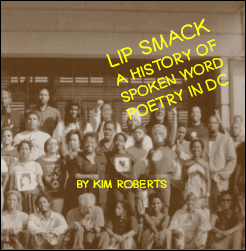
The literary scene in Washington DC, which would be a shining beacon anywhere else in the nation or the world, crouches in the dense and noisy shadow of the national government and all its multitudinous personalities' to-ings and fro-ings and shennanigans from Capital Hill to K Street & etc. Alas! Anyway! I'm a jump-up-and-down fan of Kim Roberts' splendid work, both as a poet and as an advocate for poetry, and not only within the Beltway, but radiating far beyond. The author of three books of poems, including the forthcoming Animal Magnetism, winner of the Pearl Poetry Prize (Pearl Editions, January 2011), Roberts also edited the anthology Full Moon on K Street: Poems About Washington, DC (Plan B Press, 2010) and, for over ten years, has edited the acclaimed online journal Beltway Poetry Quarterly. Her new book is Lip Smack: A History of Spoken Word Poetry in DC (Beltway Editions, September 2010, in partnership with The Word Works, Inc. and the Humanities Council of Washington, DC), for which there will be two -- both free and open to the public-- launch events:

Tuesday, September 21, 2010 at 5:00 pm
As part of The Humanities Council of Washington, DC 30th Anniversary Celebration and Grantee Showcase. Exhibits, readings, performances, and film, with an awards ceremony, and a champagne and cake reception. Historical Society of Washington, Old Carnegie Library, Mount Vernon Square, DC. (202) 387-8391. (Free, but reservations required.)

Friday, September 24, 2010 at 5:30 pm
Featuring Kim Roberts, with performances by Chris August, Twain Dooley, Gowri K, and Patrick Washington 15th Annual Baltimore Book Festival, Festival Stage, Mount Vernon Place, 600 block of North Charles Street, Baltimore, MD.

Over to you, Kim!


Washington, DC is one of several cities at the forefront of the development of spoken word, notable especially for its development of youth poetry slams (we were the first city to have one!), the range of organizations that nurture women performers in particular (or were run by dynamic women performers such as Toni Blackman and Toni Asante Lightfoot), and for being the only city in the nation to offer monetary grants to support hip hop arts and culture. Lip Smack, arranged in a timeline format, covers the years 1991 to 2010. For more information, or to order a copy (for only $10!): http://www.kimroberts.org/publications.html

Want to hear the poetry? Here are my top five spoken word venues in the Washington DC area:

# 1. Busboys and Poets
Three combo restaurants and performance spaces, Busboys has named a Poet-in-Residence at each, and runs several popular ongoing reading series. The two locations in DC are at 14th and V Streets NW, where Derrick Weston Brown hosts the 9 on the 9th series, usually packed, and at 5th and K Streets NW, where Holly Bass reigns supreme over their Open Mic series. Busboys is also home to the DC Poetry Slam Team.

# 2. Sulu DC
A monthly showcase of Asian American and Pacific Islander American performers that takes place at Almaz Restaurant and Lounge in the U Street neighborhood. Events usually combine spoken word with live music, stand-up, and video. Try to catch Regie Cabico when he takes the stage.

# 3. mothertongue
Although this series has reduced its programs from monthly to about four showcases a year, it is still going strong. Performances take place at the Black Cat on 14th Street NW, and admission fees benefit a rotating series of area nonprofit social service organizations. This all-women performance venue has nurtured some of the region's top performers.

#4. DC Guerilla Insurgency
Although they run an indoor space in the colder months, the way to really experience this group is on warm nights when they converge on Dupont Circle. The insurgency specializes in poetry of confrontation and resistance, to a backbeat of hand drums.

# 5. Beltway Slam Team
There are two slam teams representing DC, as of this summer. The DC Slam Team meets monthly at Busboys, but a looser, more interesting group has formed that combines spoken word performers from DC and Baltimore. Meeting monthly at The Fridge in the Barracks Row section of the Eastern Market neighborhood. Try to catch Chris August or Sonya Renee.

--- Kim Roberts


---> For the archive of Madam Mayo guestblog posts, click here.

Wednesday, September 08, 2010

Guest-blogger Richard Goodman on 5 Wondrous Works of New York Art

It's an honor and delight to once again host my amigo, Richard Goodman , founding member of the New York Writers Workshop and author of French Dirt and The Soul of Creative Writing, apropos of his latest, A New York Memoir. Over to you, Richard!

A New York Memoir is, essentially, a long love letter to New York City. It covers a period of thirty-five years, beginning with my knock-kneed arrival at Port Authority in 1975 down to the present day. The book consists of fourteen essays that chronicle people I've met and the inspiration I've received as a writer living here. It shows what it's like being young here, growing here as an artist and person, and growing old here. The author Susan Vreeland said the book is "a heart laid bare." I hope so.

Now comes the hard part. Maybe even harder than writing the book. Five links to....New York? This produced some intensive head scratching, and I can't afford that with what little hair I have. Just thinking of five books about New York (no movies? no plays?) would make me bald. So, I'm resigned to the fact that any list I create will seem insufficient. Given that, I decided to list five links to works of art about New York, regardless of genre, that express what was, and continues to be, one of my chief, valued reactions to New York City: a sense of wonder. Here they are:


1. Weegee's photography
Born Usher Felig, he became, simply, Weegee. As a professional photographer, he literally covered the waterfront in the 1930s, '40s and '50s. His black and white photographs of basic New York City street life are raw, real and intimate. Henry Miller called Brassaï "the eye of Paris." For me, Weegee was the eye of New York.

2. Paul Mazursky's 1976 film, Next Stop, Greenwich Village
The wonderfully romantic vision of 1950s bohemian New York is obviously autobiographical. It's suffused with a protective tenderness. It's also passionate and, when the main character's-- a young actor, of course-- mother, Shelley Winters, is on screen, terrifically funny. I don't know of a better expression of what it's like to "embrace New York with the intense excitement of first love."

3. E. B. White's Here is New York
Which brings me to the author of those quoted words above, E.B. White, and his little gem of a book, Here is New York. I don't claim to have read even a quarter of the books written about New York, but of the books I have read, this is by far the best, the most true. White captures the soul of New York City. Though he himself describes it as "a period piece," he is, for once, wrong. See for yourself.

4. Ralph Ellison's Invisible Man
I read Ralph Ellison's Invisible Man at the perfect moment: when I first arrived in New York. I identified with it totally. Yes, it's about a young black man who arrives in the city twenty or so years earlier than I did and who lives in Harlem and becomes involved with a white-directed socialist cause, but those are just details, details. The book is about the great impact New York has on a young man's psyche and how he contends with new emotional realities he never could have imagined.

5. Eloise
Finally, on an entirely different note, I offer you Eloise. Yes, that six year-old, obviously wealthy, privileged little girl who lives in the Plaza Hotel where Fifth Avenue meets Central Park. Not the kind of existence I have even remotely had here. So, why Eloise? Because for many a child-- and I would suppose more girls than boys, but not exclusively so by any means-- Eloise is New York. This is probably true much more for my generation, and I really have no idea of how many kids still read Eloise, but I would bet that she, and Holly Golightly, have been responsible for the purchase of many a train and plane ticket to New York by eighteen year olds.

--- Richard Goodman

---> For the archive of Madam Mayo guestblog posts, click here.

Wednesday, March 24, 2010

Guest Blogger Jennifer Silva Redmond on 5 Favorite Short Story Collections

Guest-blogging today is my amiga, Baja Buff Jennifer Silva Redmond, who wears three sombreros, as it were: blogger, writer, and editor. Her new blog is Jenny Redbug: Words and Pictures About Writing, Books, and Life Aboard a Sailboat; her recent short fiction appears in Daniel Olivas's recent anthology, Latinos in Lotusland: An Anthology of Contemporary Southern California Literature and, as editor, her latest publication is an anthology she edited with Roger Aplon, A Year in Ink, which she tells you about below. Over to you, Jennifer!

Five Favorite Short Story Collections

These five are my current favorites-- and I'm so into short stories right now having read dozens of short stories last year, in order to prepare myself to read 150+ story submissions as prose editor of an anthology. More on that later.

1. I started with a great collection edited by Stephen King, The Best American Short Stories 2007; sure, it was a couple years "old" but with timeless literature, who cares? Plus, I love Stephen King and I don't care who knows it! (No one can mix the awful/gruesome/eerie with the hilarious like King. No one.) Anyway, the 2007 collection is excellent and varied, and King's intro is a wonder-- I wish he would write more essays. As to the stories/authors included, any book that includes T.C. Boyle's story "Balto" can't help but move you, and the list goes on and on. Here's a fine review of the collection from bookslut.

2. The beautiful pieces in Lavanderia: A Mixed Load of Women, Wash and Word were often heartbreakingly sad, but always rang true. Poet Jimmy Santiago Baca called Lavanderia "the nitty-gritty life of suds, soap, bleach, love, hurt, loss, resentment - in short, life with blood stains that don't wash out, of memories blowing like sheets in the wind." The story behind the collection of spoken word pieces, prose, poetry and photographs is a pretty good story, too-- you can read about the project and The Wash House Collective on their website.

3. I reread Guacamole Dip: From Baja, tales of love, faith--and magic by Daniel Reveles, which I'd edited a couple of years earlier. And, yes, it was just as good, if not better than I remembered. I especially like the story about the modern-day "hardboiled" P.I. who takes a job in Tecate, not having ever been south of the border; the character is a Latino who speaks no Spanish and the results are hilarious and eventually life-changing for him. Reveles' characters are real and warm and funny, but don't think for a moment that this talented author can't still shock you-- one of these stories has an ending that you definitely won't see coming! Daniel's website is a lot of fun--take a minute to visit him there, or read this exceptional article about Reveles by Arthur Salm. One of Reveles' stories, from Tequila Lemon and Salt, was also featured in the very fine anthology Mexico: A Travelers Literary Companion, edited by Madam Mayo herself.

4. Having finished the anthology selection, I swore off short story reading for a while-- then I met Midge Raymond at the Southern California Writers Conference and was inspired to buy her new collection, Forgetting English. A wise choice: the stories all have a theme of strangers in a strange land-- sometimes the characters may think they are in familiar territory, but that usually turns out not to be the case. I like this short interview with Raymond in The Short Review.

5. As I said earlier, I edited the prose for A Year in Ink, vol 3, an anthology published by the San Diego Writers, Ink (SDWI); I'm adding that collection to this list, because it's an exciting and eclectic mix of voices and of pieces (many are flash fiction and some are short-shorts). The anthology also contains poetry, which was edited by Roger Aplon, a great poet--you may hear him read his poetry on his very cool author site. Should you care to buy a copy, you might like to know that all the proceeds benefit ongoing writing programs at the non-profit SDWI; check out their site to buy the book or to read all about them. The book is also available on Amazon, here.

--- Jennifer Silva Redmond

---> For the archive of Madam Mayo guest-blog posts, including from King of the Baja Buffs Graham Mackintosh, travel writer Isabella Tree, Zen organizer Regina Leeds, and writer and blogger Daniel Olivas, click here.

---> See also Jennifer Silva Redmond's previous guest-blog post for Madam Mayo, Five Favorite Baja California Writers' Websites.

P.S. My anthology, Mexico: A Traveler's Literary Companion, which Jennifer mentions, is a collection of 24 works by contemporary Mexican writers. These include leading literary figures such as Agustin Cadena, Carlos Fuentes, Monica Lavin, Angeles Mastretta, Carlos Monsivais, Pedro Angel Palou, and Juan Villoro. Daniel Reveles's story, set on the border in Tecate, was so hilariously perfect, it opens the collection.

Wednesday, August 26, 2009

Guest-Blogger Dylan Landis: 5 Magnetic Spaces

One of the books I am most looking forward to reading is my fellow Sewanee Writers' Conference alum Dylan Landis's Normal People Don't Live Like This, a novel in stories which is already--- it won't even be published until September 28th--- generating a hive 'o buzz. You'll be able to buy it on amazon.com shortly, but better yet, meet the author and get an autographed copy at Washington DC's venerable Politics & Prose on Sunday October 11th @ 1 pm. Dylan Landis shares an unlikely background with Edith Wharton: prior to embarking upon her literary career, she was an expert interior design writer. So it's no surprise that when I asked her to guest-blog with 5 in-some- way-relevant-to-her-book links, they were all about spaces. Read on.


I'm obsessed with ruined houses, grottoes, rooms that appear in dreams, underground places that invite trespass--even hoards and the distress that hums from deep within them. None of these mysterious spaces made it into the books I used to write on interior design. Five links I find magnetic:

1. I was fifteen when my diary got read at a friend's house, and never kept another. But visiting Paris I kept a travel journal for Leah, a teenage girl in Normal People Don't Live Like This, and she adored the exquisite bone-bejeweled rooms of the Paris catacombs; she took notes down there for hours, and it led to the story "Delacroix."

2. This dreamlike aviary at the Villa Arvedi in Italy was photographed by photographer Douglas Busch (who builds his own cameras); a copy hangs over my writing desk. Two of my characters, both mothers of teenage girls, have repeating dreams about finding a secret room. This could be one of those rooms.

3. The Collyer Brothers could barely squeeze through the accumulated hoard in their 12-room Harlem mansion; it subsumed 84 tons of inherited and scavenged stuff--newspapers, pianos, chandeliers, a horse's jawbone, clocks, and eventually their own bodies. E. L. Doctorow's new novel, Homer and Langley, mines the story; so does the Frank Lidz bio Ghosty Men.

4. Heartbreaking and mesmerizing: the abandoned Cane Hill Asylum in London—where both the vacant rooms and scattered patient records have stories to tell.

5. It's illegal to set foot on North Brother Island in the East River of New York, where an overgrown quarantine hospital still stands--along with the cottage where Mary Mallon, whom the press called Typhoid Mary, spent her last years. (I'm writing a novel about her now.) Photographer Rachelle Fernandez captured the haunted quality that survives here.

--- Dylan Landis


P.S. Dylan Landis's work is featured in Richard Peabody's latest anthology of Washington women writers, Gravity Dancers.
---> To view the archive of Madam Mayo guest-blog posts, click here.