Sunday, February 25, 2018

Novelist Leslie Pietrzyk on the Siren Song of the Online World & on Writing SILVER GIRL

Get this book from:
The Seminary Co-op
Politics & Prose
Amazon
and just about everywhere else

A bouquet of bienvenidos for new readers of this blog in 2018. And as you long-time readers know, I post here at "Madam Mayo" blog on Mondays. For 2018, Monday is still the magic day, and every fourth Monday of the month will feature either a post on cyberflanerie or a Q & A with another writer, poet, and/or literary translator.

[>>CLICK HERE TO CONTINUE READING THIS POST ON THE NEW SELF-HOSTED WORDPRESS SITE, MADAM-MAYO.COM]

This first Q & A for 2018 is with crackerjack literary novelist, short story writer, and essayist Leslie Pietrzyk who has a new novel out this month, which I cannot wait to read. Silver Girl is the title, and it has already been garnering outstanding reviews, including a starred review from Publisher's Weekly. (For the unititiated, a starred review in Publisher's Weekly is a B-Freaking-D for which, lest you own a wine shop, you do not have enough champagne.)


More fiction by Leslie Pietrzyk:
Pears on a Willow Tree
A Year and a Day

This Angel on My Chest
Pietrzyk is also the author of This Angel on My Chest, winner of the Drue Heinz Prize for Short Fiction; and the novels A Year and a Day and Pears on a Willow Tree.


C.M. MAYO: You have been a consistently productive literary writer for many years. How has the digital revolution affected your writing? Specifically, has it become more challenging to stay focused with the siren calls of email, texting, blogs, online newspapers and magazines, Facebook, Twitter, and such? If so, do you have some tips and tricks you might be able to share?

Leslie Pietrzyk,
author of SILVER GIRL
LELSIE PIETRZYK: Oh, yes, yes, yes…I’m a sucker for that siren song of the online world. I’m not sure I’ve come up with the answer for maintaining focus, but sometimes I’ll try setting timers (say, no Facebook until two hours have passed) or working late at night (fewer people online to chat with). I don’t answer email on the weekends.

But what works better for me (unless I’m kidding myself), is that I’ve become more open to working WITH social media and the wide world of Google available while I’m writing. Why knock myself out trying to imagine the color of nail polishes in 1982 when I can simply Google for an answer and see an array before me? Why berate myself for dipping into Facebook for five minutes? Why not just accept that distractions are part of our world now and try to retrain myself to write deeply amidst them?  

CM: Are you in a writing group? If so, can you talk about the members, the process, and the value for you?*
LP: For many years I was in an incredible, high-level writing group of 6 women who shared novels-in-progress…dear Madam Mayo belonged to this group! I think I learned how to write a novel from these monthly meetings.

When the group dissipated after 10 years, I was—honestly—tired of having critical voices in my head. Plus, I was in the beginning phases of putting together a story collection that was linked unconventionally, by incident (in each story, a young husband dies suddenly; the book became This Angel on My Chest). Because what I was doing was so difficult, and because I didn’t know how on earth I was going to make this premise work, and because I didn’t want to hear one word about my flailing, I decided that it was time for a different kind of group.

I started my neighborhood prompt writing group, and we meet once a month and write for 30 minutes to open-ended, one-word prompts. We can read out loud or not, and there are no critiques, only admiration. We’ve been meeting for more than 5 years now, and chunks of Silver Girl emerged from these meetings.

(Here’s an article about how to start your own prompt writing group: http://www.workinprogressinprogress.com/2015/02/whatever-works-works-start-your-own.html )

CM: Did you experience any blocks while writing this novel, and if so, how did you break through them?
LP: My biggest block actually came right at the beginning. I had been writing character sketches and scenes in my prompt group for at least eighteen months before I started the book in earnest, so I had all this material. My two college girl characters were dark and edgy and complicated, and I’d teased out a ton of fascinating history to their relationship. When I finally finished This Angel on My Chest I thought it would be a simple glide right into the new book…but I realized immediately that my complicated, interesting characters had no plot! It was a humbling moment.

I started doing more research into the Tylenol murders in the early 80s (which is the backdrop for the book) and focused on brainstorming potential connections between my girls and that event. I won’t say I ended up with an outline per se, but eventually I found a path for the book’s events. (Nor will I say that anything about writing this book was a “simple glide”!)

CM: Back to a digital question. At what point, if any, were you working on paper for this novel? Was working on paper necessary for you, or problematic?
LP: I never thought I’d say this, but paper was very important! I’m usually all-computer-all-the-time, but I’ve found that writing to prompts on paper feels freeing and takes my mind to riskier, more interesting places. So I wrote about Jess and the unnamed narrator many, many times across several little notebooks. The problematic parts came in trying to locate scenes I was sure I’d remembered writing, and when I had to type into the computer, a task I despise. Perhaps even more problematic is the constant fear that I’ll lose one of my notebooks to carelessness or fire before I transcribe its contents!

CM: Do you keep in active touch with your readers? If so, do you prefer hearing from them by email, sending a newsletter, a conversation via social media, or some combination?
LP: I’m far too disorganized to send a newsletter. Also, I retain enough Midwestern upbringing to wonder, who wants to hear from me? An email from a reader is always a fun surprise or a tweet…but I’m still loyal to Facebook. I generally post publically so anyone can follow me. I’ve actually come to know many readers and writers through my FB scroll. And for real old-school types, I’ve still got my literary blog!** I used to be very reliable about posting and am erratic now, but I hope the site still retains a scrap of personal flair: www.workinprogressinprogress.com

Email access is on my website (along with some of my favorite recipes): www.lesliepietrzyk.com


# # # # 

*CM: I too left our writing group, and for similar reasons. (I was about half way into an epic and epically complex historical novel, and after I got rolling with that, receiving critiques from other writers who were, of necessity, reading 30 pages out of context, was turning into more trouble than it was worth to me-- and, to further complicate matters, I was transitioning to living in Mexico City again.) Nontheless I remain immensely grateful for members' critiques of the beginning drafts of this novel, as well as of several other short stories and literary essays. And I miss the comraderie of those meetings with such excellent friends and esteemed colleagues. Those years for me personally, and for my writing, were a rare blessing.
**CM: For anyone interested in writing and publishing literary fiction, Leslie Pietrzyk's Work-in-Progress blog is a read well worth your while.

> Your comments are ever and always welcome. Write to me here.

Blast from 2008! 


Sunday, February 18, 2018

Two Tools for Speed and Fun with Email

As announced in my last post of last year, in 2018 I will continue to post on Mondays, with the first and third Mondays of the month devoted to posts related to my own work and/or work-in-progress. 

How I wish I could be posting about a new podcast or excerpt from my book-in-progress, but this finds me still mired in the mudslide of tasks post-household move #2.

The first move was late last summer, and a second one last fall, the furniture and Texas Bibliothek arriving on the other side of the ocean only last month... (It was actually substantially more than two moves but I won't bore you with the details.)

One of the tasks in the mudslide is catching up on email.

Those of you who have been following this blog well know that email management is a subject I have been tangling with, and fascinated by, for an age-- well, since 1996, when I first got an email account, as a matter of fact. Back in 2016-- before the moves-- I had made such substantial progress with my email process that I posted this blog's all-time most popular post:


I still stand by my 10-point protocol; however, I now consider that post as less a celebration than a handy reminder to myself to take my own advice as life's Black Swan-esque episodes may demand. 

Over the past months, further refinements with my email process, such as using a Zassenhaus timer helped, as did insights from further noodling... But moving house being the utter chaos that moving  house is, the email backlog accumulated up to, understandably, one heckuva Himalaya.

Now it's already more a Sierra Madre; daunting, yes, but with relatively more sky. But of course I'm aiming for a wide sky over low rolling hills... And it's getting rather tiresome to be starting almost every single email with an apology for the delay.

Over the past few weeks two new things have helped me make faster progress and at the same time have some fun. Herewith:


#1. I now use the Mr. Stopwatch app for batching email. 

This not just another stopwatch app; I can click on the option to have each elapsed minute loudly announced by, I presume, the app designer, which is so perfectly annoyingly perfect.

What do I mean, perfectly annoyingly perfect? One of the problems I've had is, ironically, spending too much time on email and so ending up dithering around in a Ludic loop. I find I can work down more of my email backlog when I process it in batches of say, 20 minutes-- and the trick is to actually stop after 20 minutes. With the audio on-the-minute option, Mr. Stopwatch is so annoying -- which is perfect for me!-- that I usually yearn to stop after 10 - 15 minutes, which is even better.

For email, Mr. Stopwatch beats the Zassenhaus. Anyway, I forgot to pack my Zassenhaus.


Screenshot from my new favorite app, Mr. Stopwatch


My writing assistant with a small selection of postcards
soon to be mailed.
#2. Whenever apt, and if I feel so moved, I send a postcard instead.

Inspired by Karen Benke's Write Back Soon! I have begun keeping a batch of postcards handy near my laptop.

I myself am charmed to receive postcards (I mean personal, not junk mail, of course), so I would assume that some of my correspondents might feel the same way-- and so, with a postcard I can say hello to friends and family without adding another email to their personal Himalayas or Alps, or speedbumpitos, or what have you.

P.S. Nope, no Whatsapp, no FB, and I have largely abandoned Twitter. And I just might start typing my postcard messages on a typewriter! But I have to get another typewriter. For reasons too ridiculous to elaborate on here, I had to leave my beautiful 1961 Hermes 3000 on the other side of the ocean.

All this said, I sincerely do appreciate email.

> Your comments are always welcome. Write to me here.


Sunday, February 11, 2018

New Resources for Writers

As announced in my last post of last year, in 2018 I will continue to post on Mondays, with the second Monday of the month dedicated to my writing workshop students and anyone else interested in creative writing.


CLICK HERE
to visit my "For Writers" pages

Get this book from
The Seminary Coop
Since the year 2000 I have maintained "For Writers," an ever-evolving series of webpages within my main website. Updates are now live on three of those subpages:

+ Recommended Reading on Creative Process
New on the frequently updated list: Elizabeth Gilbert's Big Magic: Creative Living Beyond Fear. I listened to the audio edition, read by the author, and it was such a trove of wisdom, I listened to it again.

> Visit the main "Recommended Reading: Creative Process" page here.

+ Resources for Writers: Tips & Tools
Updates on ye olde article "Ten Tips for Getting the Most Out of Your Writing Workshop."

> Visit the main "Tips & Tools" page here.

+ Resources for Writers: On Publishing
Several updates on ye olde article, "Out of the Forest of Noise: On Publishing the Literary Short Story," including new links to a treasure of a resource, Clifford Garstang's Perpetual Folly Literary Magazine Rankings for fiction, nonfiction, and poetry. Thank you, Clifford!

> Visit the main "On Publishing" page here.

P.S. Help yourself anytime to "Giant Golden Buddha" and 364 More Free Five Minute Writing Exercises. The exercise for today:
February 12 "Popol Vuh: Seven Random Bits"
I just pulled the Popol Vuh off the shelf and found these seven random bits:
 
~sweet drink!
~Jaguar
~undone
~you tricksters!
~And they remembered what had been said about the East.
~vagabonds
~corn with fish
 
What can you write in five minutes that incorporates all of these?
Alternatively, pull a random book from your own shelves for your own random seven bits, and do five minutes of writing incorporating those.

> Your comments are always welcome. Write to me here.


Monday, February 05, 2018

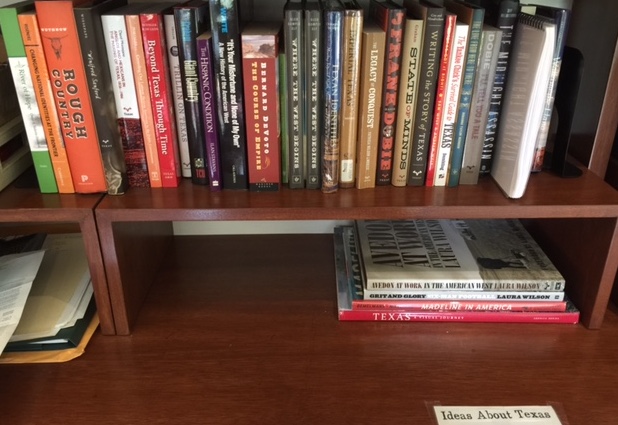
On Organizing (and Twice Moving) a Working Library: Ten Lessons Learned of Late with the Texas Bibliothek

[ The Texas Bibliothek, Ready to Ship.
Yes, it is big. Yes, I devour books like a ravenous owl.
Yes, this is my process.
I accumulated similar-sized working libraries
in writing some of my other books, e.g.,
Miraculous Air: Journey of a Thousand Miles through Baja California (2002);
The Last Prince of the Mexican Empire (2009); and
Metaphysical Odyssey into the Mexican Revolution (2014). ]
File this post under Future Reminder to Take My Own Advice, and if some or all of these ideas also work for you, gentle reader, verily I say unto you: Wunderbar!

[>>CONTINUE READING THIS POST AT WWW.MADAM-MAYO.COM]

Late last September, having finally rearranged and set up my working library in my new office in Mexico City-- the work in question being a book on Far West Texas-- I had to pack it all back up again and ship it across the Atlantic. (Why? Well, that's a novel I'm not going to write, both literally and figuratively).

Now that I've got my Texas books resettled on their second set of new shelves in less than six months, I'm ready to take on 2018! But whew, I've got biceps after this job for a Hercules. The thirty-eight boxes of books comprising what I now call the Texas Bibliothek-- I have landed in German-speaking Switzerland-- arrived in mid-January. And a couple weeks later, every tome and paperback and pamphlet and back-issue of Cenizo Journal is in place, and I can carry my bike over head! I could scoop up and toss dessicated Christmas trees, small donkeys and their Schmutzlis out windows, too, should I take a notion!


ON ORGANIZING (AND TWICE MOVING) A WORKING LIBRARY:
Ten Lessons Learned of Late with the Texas Bibliothek

1. Organize the books by topic-- not as a librarian would recommend, but as your working writer's mind finds most apt. 

After all, you're the one who will be using these books, not the general public. And even in a fairly substantial working library, such as this one, there are not enough books to justify the bothernation of cataloging and labeling each and every title.

[ Ideas About Texas (some, anyway)]
If you have more than 50 books and if you do not organize them in some reasonably reasonable way, why don't you just open your front door and let your dogs wander out and then you can go looking for them on the freeway at four a.m., that might be more fun!


2. If any category has more than 30-40 books, create a new subcategory.

Because trying to keep books in alphabetic order, whether by author or by title, makes me feel dehydrated, RRRRRR.

3. Label categories of books with large, easy-to-read lettering. 

Because if you're a working writer, like me you're probably near-sighted...

Funny how book designers always have such unique ideas about colors and font sizes and typefaces.... In other words, I don't want to have to look at the visual clutter of those spines to try to figure out what this bunch is about; I let that BIG FAT LABEL tell me.

If you do not want to make labels, why don't you peel the labels off all the jars and cans in your pantry, mix 'em up, and then try to find which one is the dog food and which one the canned pumpkin? That would be a mile more hilarious.

4. When moving, before touching anything, take photos of the whole shebang.

I do not have early onset dementia, but boy howdy, moving house sometimes makes me feel as if I do. (Did I used to have a working library? Was I working on a book? What day is it? Is Ikea still open?)

5. Then, before even touching those books, take a tape measure and write down the inches of shelf space required for each and every category.

[ I suspect that these things are in cahoots
with pens and umbrellas. ]
A tape measure!

I realize this may sound very OCD.

But three moves ago, it did not occur to me to do this with my working collection on Mexico's Second Empire / French Intervention, for my then recently-published book, The Last Prince of the Mexican Empire. In the rush of moving I allowed the moving company crew to pack the books, willynilly-fefifo-rama-chillydilly, and then, on arrival, lacking space, never mind bookshelf space, and so having to leave that particular library in a half-unpacked, unsorted chaos, for the next few years more correspondence and related research was bottlenecked than I want to think about. (That library now has its home in Mexico City-- that would be another blog post.)

The main thing is, you want to be certain you actually have the bookshelf space you need plus ample wiggle room for each  category before you start packing-- and then double check the available bookshelf space again before you start unpacking.

And never, ever let anyone else pack them.

Sounds obvious. Alas, for me, three moves ago, it was not.


[ Yeah, Literary Nuns! (Note label in upper right corner) ]


[ Geology, Energy, Box 1
corresponded to category 40,
requiring 17 inches of shelf space. ]
6. Save those neatly made shelf labels to reattach to the new shelves, and also label-- with mammoth, easy-to-read fonts-- each and every box.

7. Number each box, e.g., 1 of 32; 2 of 32, etc.

These can be cross-referenced with the master list of categories, which has the measurements.

8. Don't be stingy with boxes!!

For moving books I prefer the so-called banker's boxes with punch-out holes for handles. Banker's boxes are large enough to take a heaping helping of books, and the handles make them easy to carry, however the weight of a book-filled banker's box remains within the range of what I, a 50-something female whose daily mainly workout consists of walking two pugs, and, la-de-da, whatever biking and yoga, can easily haul up or down a staircase.

Yes, you could snag a batch of free boxes at the grocery store, and yes, you probably could, as I certainly could, lift bigger boxes with double the number of books in them-- and most men can haul a stack of two or even three bigger boxes at a time. However, whatever the upper-body strength you have and shape you are in, when you are moving house, unless you for some reason enjoy showering hundreds of dollars on, say, your chiropractor's vacation home, lifting huge, ultra-heavy, and unwieldy boxes is penny wise and dollar dumb. Ox dumb.

Goodie for me, I learned this lesson three moves ago, and I had an excellent chiropractor.

9. Take photos of the boxes, labels included.

Because you never know! Seems I have good moving juju. Knock on wood for next time!

10. On reshelving day, gather together before commencing:
+ Papertowels
+ Cleaning spray for the shelves (they will be dusty)
+ Garbage bag
+ Tape
+ Scissors (to trim off old bits of tape, etc.)
+ Measuring tape!!!!!!!!!!
+ Step stool or small ladder
+ Water and snack
+ iPad with audiobooks and/or podcasts and/or dance music 
P.S. History nerds podcast alert! Check out Liz Covart's Ben Franklin's World

If you are missing any one of these items, you will probably have to interrupt whatever you are doing to go get it, and then in, say, the kitchen, because you have Moving on the Brain, you will be distracted by some zombie command from the dusty ethers such as, I must now go to Ikea to buy garbage bags and whatnotsy whatnots...

+ + + + + + + +

Meanwhile, dagnabbit, people just won't stop writing books on Texas!! Two more, post-move, essential additions to the Texas Bibliothek:

Regular Army O! Soldiering on the Western Frontier, 1861-1891
By Douglas C. McChristian

The Earth is Weeping: The Epic Story of the Indian Wars for the American West 
by Peter Cozzens

+ + + + + + + +

Wish me luck, gentle reader. I aim to finish my book on Far West Texas this year. By the way, I host an associated 24 podcast series, "Marfa Mondays," which is woefully behind schedule because of these moves, but soon to resume. I invite you to listen in anytime to the 20 podcasts posted so far.

Listen in anytime
P.S. Using the free blogger platform, I also maintain an online working library of out-of-copyright (now in the public domain, mainly linked to archive.org) Texas books-- books which I could not or did not want to attempt to purchase but would like to be able to consult at my leisure. It includes a number of titles that might appear bizarrely out of place (one is on Massachusetts, for example)-- but after all, this is not for the general public, but a working library in service of my book in-progress. I mention this because perhaps you might find it of use to create such an online library for your own purposes.

My working library of out-of-copyright Texas books, mainly from archive.org
I make no claims for its usefulness to anyone else.


P.P.S. For those wondering, what is my take on ebooks? First of all, I delightedly sell them!  And yes, I have bought some, and as far as the Texas book research goes, when I need a book urgently and/or the paper edition is unavailable or expensive, I have been known to download a Kindle or four-- or, as above-mentioned, download out-of-copyright books for free from www.archive.org and similar sites. I appreciate that convenience, and also the ease with which I can search within a text for a word or phrase. Nonetheless, on balance, I find ebooks decidedly inferior to paper. Morever, I doubt that my electronic libraries will outlive me in any meaningful way, while I expect that my working libraries of hardcovers and paperbacks, including some rare editions, may serve other researchers well beyond the horizon of my lifetime.

> Your comments are always welcome. Write to me here.


+ + + + + + + +

As anounced in the last post of 2017, in 2018 I will be posting on Mondays on the following schedule:

First and third Mondays of the month: New writing / news / podcasts;
Second Monday: For the writing workshop;
Fourth Monday: Cyberflanerie and/or Q & A with another writer, poet, and/or translator;
Fifth Monday, when applicable: Whatever strikes my gong. 


Monday, December 25, 2017

Top Posts of 2017 & A-Yonder into the Foggy Wilds of 2018 (Resuming February 5, 2018)

This was the year ye olde "Madam Mayo" blog went to posting on Mondays only and, if I do say so myself, the content improved by a notch or five in crunchiness. Herewith some faves:

March 20, 2017


# # #


November 13, 2017

# # #


December 12, 2017


# # #

Essays published this year, mentioned on the blog of course, include

"Dispatch from the Sister Republic or, Papelito Habla"
(Dancing Chiva, Kindle)
Kindle

# # #

"Tulpa Max or, Notes on the Afterlife of a Resurrection"
(Catamaran Literary Review and in Spanish, Letras Libres)
a post about that:
(On the 150th Anniversary of the Execution of Maximilian von Habsburg)


# # #

Prologue to the book by Luis Reed Torres, El Libertador sin patria
a post about that:
The Liberator Without a Country


# # #

Review of Patrick Dearen's Bitter Waters: The Struggles of the Pecos River
a post about that:
Bitter Waters


# # #

Not yet published but available as a PDF, also mentioned on the blog:

"The Secret Book by Francisco I. Madero, Leader of Mexico's 1910 Revolution"
an edited transcript of my presentation of my book,
Metaphysical Odyssey into the Mexican Revolution:
Francisco I. Madero and His Secret Book, Spiritist Manual,
at the Center for Big Bend Studies Conference, 2016
Sul Ross State University

a post apropos of that:
Waaaaay Out to the Big Bend of Far West Texas,
 and a Note on El Paso's Elroy Bode
December 3, 2017

and another post apropos of that:
Three Fabulous Things About Ciudad Juárez
November 20, 2017


# # #

Translations published this year:

"The Cafe" by Rose Mary Salum in Catamaran Literary Review
a post about that:
Catamaran and Tiferet: Two Very Fine Literary Journals
February 27, 2017


# # #

"The Apaches of Kiev" by Agustin Cadena, Tupelo Quarterly
a post about that, and more:
Spotlight on Mexican Fiction
August 7, 2017
Mexican writers in Agustín Cadena's anthology, Callejeros
Front row: 
León Cuevas, Sandra Luna, Agustín Cadena
Back row:
 Eduardo islas, Cristina Manterola, ?, ?, 
José Antonio Bautista, Silvia Cuesy


# # #

FOR THE WRITING WORKSHOP

May 29, 2017
March 13, 2017

# # #


September 4, 2017


# # #


November 27, 2017

# # #

Remembering Ann L. McLaughlin
December 18, 2017


# # #


CYBERFLANERIE

October 23, 2017
"Typewriter Manifesto" by Richard Polt


# # #

Five Video Poems to Watch
June 5, 2017

# # #


Q & A

May 22, 2017

# # #

January 2, 2017


# # #


A-YONDER INTO THE FOGGY WILDS OF 2018

Monday posts will resume on Febrary 5, 2018. Topics vary, invariably crunchy.

In 2018 I will be finishing the book and related podcasting project on Far West Texas. My poetry collection, Meteor, won the Gival Press Poetry Prize and will be published in the fall of 2018, so as the year progresses, you can expect more posts with poetry, and perhaps also, time permitting, new video poems.

Towards further balance and consistency, I'll be posting on this schedule:
First and third Mondays of the month: New writing / news / podcasts;
Second Monday: For the writing workshop;
Fourth Monday: Cyberflanerie and/or Q & A with another writer, poet, and/or translator;
Fifth Monday, when applicable: Whatever strikes my gong. 

Because of a bunch of becauses I'll be taking off the month of January. In the meantime, my warmest good wishes to you and yours for the holidays and new year.

> Your comments are always welcome. Write to me here.


Monday, December 18, 2017

Remembering Ann L. McLaughlin

Time snaps by. It is has been two days from a year since Ann L. McLaughlin passed away. How I miss my brave, graceful, and very wise friend. Ann was a decade older than my mother but, curiously, that did not occur to me until she had passed: There was something ageless about her. She was a literary scholar and later, when I knew her, a writing teacher and an artist, a novelist of the most seriously dedicated and generous of our kind.

I met Ann in, I think it was 1999, when, having just moved to the area, I read from my short story collection at the Writer's Center, in Bethesda MD, just outside Washington DC; as a founding faculty and board member, Ann did me the honor of so welcomingly introducing me to that audience. Shortly thereafter, thanks to a good word from poet and Gargoyle editor and publisher extraordinaire, Richard Peabody, I joined a writing critique group. A crackerjack writing group it was! At various points it included Kate Blackwell, Susan CollKathleen Currie, Katharine DavisSolveig Eggerz, E.J. LevyCarolyn ParkhurstLeslie Pietrzyk, Amy Stolls, Paula Whyman, and Mary Kay Zuravleff, among others-- and always, always Ann.

[>>CONTINUE READING THIS POST AT WWW.MADAM-MAYO.COM]


Recently reprinted by Bacon Press Books
When I joined the writing group, Ann was known for her loosely autobiographical novels Sunset at Rosalie, The Balancing Pole, and Lightning in July. Of the latter, set in Boston polio epidemic of the 1950s, Publisher's Weekly lauds her "straightforward narration [that] transforms the events of a prolonged hospital stay into a richly textured tale."

Novelist Andrew I. Dayton says it best:
"So deeply tragic. So tremendously sweet. Ann McLaughlin has captured humanity at its bravest. Artistic, accomplished Hally Blessing is stricken with polio in the prime of her youth, only weeks before the first polio vaccine. Within mere hours, Hally progreses from the elation of her first major venue as a young flautist to the despair of being diagnosed with polio. Ovecoming the deep challenges of fear and disfigurement, Hally struggles to find the inner resources which eventually enable her triumph. The scenes, the characters (even the minor characters) are all vividly portrayed. This work is a victory for the human spirit." 
At that time, Ann was out and about promoting Maiden Voyage, a coming-of-age novel set in the 1920s on a newspaper magnate's yacht. From Mimi Godfrey's review in the Women's National Book Association newsletter:
"McLaughlin is a clear-eyed and observant writer, and her evocation of 1920s Washington and the exotic ports of Julia's trip-- Madeira, Alexandria, Sicily, Greece, Zanzibar, Singapore, the South Pacific-- is fascinating. But McLaughlin is more interested in charting Julia's mind and heart, offering a kind of artist-novel of her development as a journalist and fledgling photographer. Julia wrestles with questions that were as vital today as they were in 1924: What is more important for a woman, a satisfying career or marriage and a family? Do the demands of a woman's work matter as much as a man's? Julia's answers to these questions are, even more than the itinerary, what give this engaging novel its lasting satisfaction."

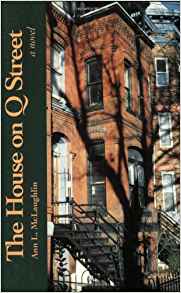
For our writing group, Ann brought in draft after draft of chapters from The House on Q Street, her novel set in Washington during World War II. After The House on Q Street came A Trial in Summer, set in Depression-era San Francisco.

And although no longer in the writing group, for I'd returned to live in Mexico City, I had a chance to read drafts from Leaving Bayberry House and the proofs for Amy & George. I was honored to contribute a blurb for the latter, which takes the reader to 1930s Cambridge, Massachusetts:
"Once again, with charm and heart, McLaughlin brings to life a tumultuous period of U.S. history as she probes and delves into a father-daughter relationship that is sometimes a seesaw, sometimes a dance. This is a wise novel."

Novelist Susan Richards Shreve adds her praise:

"George is dean of the Harvard Law School and Amy is his young, sensitive daughter. McLaughlin's skill at portraying the quiet dangers of family life which culminate in an act of violence is tempered by a generosity of spirit and disarming honesty."

As a member of her writing group I had a direct window into the effort it took to write these books. I was, and remain, in awe of Ann's discipline. No matter what, and there were whats aplenty, Ann could sit herself down in the chair every day, fire up the laptop, and do the work. She had a truly rare dedication to craftsmanship, faith in her vision, and, at the same time, the willingness and sheer grit to rewrite, and rewrite again, and again, and again and, Lordy! as her characters often said, again.

And then whenever one of her books was published-- this is especially hard for shy creatures such as writers, and no easy feat for one with health challenges-- Ann would get herself out there, she sent the postcards, kept up with the torrents of emails, and with smiling aplomb, did the many rounds of readings and signings for her books. Her book signings at Washington DC's Politics & Prose-- one of the last and most prestigious of the great independent bookstores-- were always packed, every chair taken, fans standing in the aisles.

Among the many events for her novel A Trial in Summer was a party at my apartment. Somehow, my memory of that conflates with another party, for Mary Kay Zuravleff's The Bowl is Already Broken, when Ann's husband Charlie, an esteemed historian, was still alive. He was in a motorized scooter, but he had such joie de vivre, that scooter might have been a whim of a contraption for floating out of Oz. The picture I hold most vividly in my mind is of Charlie parked in the middle of that broad room, beaming, surrounded by so many, many of his and Ann's adoring friends.

A few years after I had returned to live Mexico City, it seemed there might be a chance on the horizon to come back to DC and so, under the wing of Ann's encouragement and endorsement, I joined the board of the Writer's Center. That turned out to be a short-lived commitment on my part, alas, but what I remember so warmly-- what magical moments!-- was sitting at the table in her kitchen in Chevy Chase, petting her cat pretty Booska, while just the two of us talked writing and teaching writing and what we could do for that beloved literary oasis.

At the Writer's Center Ann's workshops were legendary. Novelist Frank S. Joseph told me, "Ann was the best writing instructor I ever had." Year after year Ann gave her students her all plus ten. I knew, from our many conversations, how much they meant to her. In most people's minds "Washington DC" does not conjure images of literary community, but the fact is, the Writer's Center is one of the largest literary centers in the United States, and the capital and surrounding area, deep into Maryland, Virginia and even Delaware, is filled with writers who, at some point, took one, two, or several of Ann's workshops.

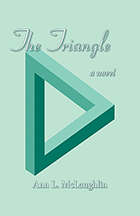
Even in her last months, her health failing, whilst in and out of hospitals, Ann kept on writing. She finished her ninth novel, The Triangle, and reviewed the page proofs. Her publisher, John Daniel, describes it thus:
"The Triangle returns to Boston's 1955 polio epidemic, and combines the theme of coping with disability with that of struggle in the father-daughter friction and frustrated love. The author seems to have written the satisfying resolution to the two overlapping conflicts in her fictive life. This powerful novel is a satisfying finale of a brilliant career."
Ann McLaughlin died at home on December 20, 2016.

I am but one of a multitude of people who can say that Ann enriched my life, both as a person and as an artist, immeasurably. Yet how fleeting the time I had with her, after all. Why did I not take one of her workshops? Why did I not ask Ann more about her friend and correspondent, John Updike, or about Janet Lewis, author of The Wife of Martin Guerre, whom she knew from her years in California? And I regret immensely that we did not talk more, in the most writerly vein, as we so easily might have, about the novels of Virginia Woolf, which she surely knew by heart, every one.

I will miss Ann for the rest of my life. Her novels, a treasure of a consolation, will always have a special place here by my desk in my writing room, and in my heart.

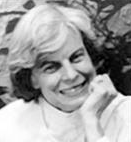
Ann L. McLaughlin and C.M. Mayo,
Washington DC, 2007
Photo by Alice Jean Mansell

# # #


Died at her home in Chevy Chase, MD on Tuesday, December 20, 2016 after a brief respiratory illness.
The daughter of James M. Landis and Stella McGehee Landis, she was born in 1928 and grew up in Cambridge, MA. She graduated from Radcliffe College in 1952 and received a PhD in literature from American University in 1978. Mrs. McLaughlin began teaching several courses every year at the Writers' Center in Bethesda when it was founded in 1976 and continued teaching until the last year of her life; she also served on the board there. She had fellowships at the Virginia Center for the Creative Arts, Yaddo, and the Studios of Key West.
Ann was the author of eight novels, all published by John Daniel and Co., and recently finished correcting the final proofs on her ninth, to be published in 2017. Her readers were particularly drawn to her portraits of girls and young women coming of age, often in Depression-era America. She wrote with feeling of the intricacy of relationships those between sisters and particularly those between daughters and their difficult, if brilliant fathers. Her long and happy marriage to Charles C. McLaughlin, professor of history and editor of the Frederick Law Olmsted Papers, ended with his death in 2005.
She overcame many challenges, including polio, which she and her husband both contracted during the 1955 epidemic in Boston, which principally affected her speech and swallowing for the rest of her life. But her temperament was remarkably buoyant in the face of adversity and she will be remembered as one of the strongest and kindest of women. She will be missed by generations of students, her family and a wide community of friends and colleagues who were inspired by her gallant, bright spirit, her humor, her gentle wisdom, and her warmth.
She is survived by her sister, Ellen McKee; children, John C. McLaughlin and Ellen M. McLaughlin; and two grandchildren, Rachel and Aaron McLaughlin.
# # # 

> Your comments are always welcome. Write to me here.