Showing posts with label El Paso. Show all posts

Monday, June 25, 2018

Notes on Tom Lea and his Epic Masterpiece of a Western Novel, THE WONDERFUL COUNTRY


This year I've been posting a Q & A with a fellow writer on the fourth Monday of the month, and while I have every intention of continuing to do so, this Monday instead herewith some notes on the epic novel by the artist who, back in 2001, passed over to the Great Beyond: Tom Lea.

> Tom Lea biography
> Tom Lea's artworks in El Paso

"It is part and parcel of your culture and I think you should cherish it," says Italian art historian Luciano Cheles of the surprisingly little-known works of El Paso, Texas painter and writer Tom Lea. And encouraging that is precisely what Adair Margo has been doing with great verve for the past many years with the website and educational programs of the Tom Lea Institute. I had the immense privilege of attending Margo's talk about Tom Lea at the Bullock Museum in Austin back on October 15, 2015. (And by felicitous happenstance, I sat next to Luciano Cheles.) More about that anon.

[>>CONTINUE READING THIS POST AT WWW.MADAM-MAYO.COM]

Here is the must-see 5 minute video with what Cheles has to say about Lea's artwork:


For more on Lea's and The Wonderful Country's place in the canon, see Marcia Hatfield Daudistel's majestic anthology, Literary El Paso (TCU Press, 2009). 


Get the TCU Press paperback edition
from Seminary Coop
et al

WILDEST WEST EL PASO

This post is prompted by my work-in-progress about Far West Texas (...stay tuned for more podcasts...)  At long, belated last I have tackled Tom Lea's epic historical novel of El Paso. 

I am happy to report that The Wonderful Country is wonderful indeed, a masterpiece not only of works set in El Paso, but in the genre of the Western, and indeed in all of American fiction.

These days most literary readers, and especially those out on the coasts, tend to turn their noses up at Westerns. Dear curious and adventurous reader, if that describes you, be assured that to overlook reading The Wonderful Country is to miss out on something very fine in U.S. literary heritage. The Wonderful Country was popular in its day, back in the 1950s, but it is not a typical commercial novel; it has a high order of literary quality; morever, its treatment of Mexicans and Mexico is unusually knowing and sensitive. (What would I know about that? Start here and here; my books are all here).

Set in post-Civil War El Paso, that is, the latter part of the nineteenth century, the first days of the railroad and the last of the free-roaming Apache, and published in the pre-Civil Rights era, Lea's The Wonderful Country forthrightly portrays many of the still painful tensions in the border region. While he writes with an unusually open heart and mind, Lea is scrupulous in rendering accurate period detail. The "N" word appears! (In the mouth of a character.) There is no lack of roastin' 'n stabbin' n' shootin' n' scalpin' and our hero is the son of a Confederate from Missouri. Vegetarians and those with flea-trigger hot-buttons, be forewarned.

From the catalog copy, TCU Press, 2002:

"Tom Lea's The Wonderful Country opens as mejicano pistolero Martín Bredi is returning to El Puerto [El Paso] after a fourteen-year absence. Bredi carries a gun for the Chihuahuan war lord Cipriano Castro and is on Castro's business in Texas. Bredi fears he will be arrested for murder once he is back across the Rio Grande. Fourteen years earlier-- shortly after the end of the Civil War--when he was the boy Martin Brady, he killed the man who murdered his father and fled to Mexico where he became Martín Bredi.
"Back in Texas, other misfortunes occur to Brady. First he breaks a leg; then he falls in love with a married woman while recuperating; and, finally, to right another wrong, he kills a man.
"When Brady / Bredi returns to Mexico, the Castros distrust him as an American, and Martin is in the intolerable position of being not a man of two countries but a man without a country. 
"The Wonderful Country is marvelous in its depiction of life along the Texas/Mexico border of a century-and-a-half ago. Lea brings to life a time that was wild, a time when Texas and Mexico were being settled and tamed. Lea knows the desert region of his birth as well as anyone who has ever written about El Paso and the great nation that borders it to the south."


NOTES ON THE TCU PRESS EDITION WITH AN AFTERWORD BY JOHN O. WEST

You should be able to scare up a first edition over on www.abebooks.com, and power to you if you want to shell out the clams for a fine first with intact dustjacket and an autograph. The copy I read is the paperback reprint of 2002 available from TCU Press (and most online booksellers) which includes afterword by John O. West, a noted US-Mexico border scholar. For West's afterword I would recommend the TCU Press paperback as your best buy (unless your main goal, buck for buck, is to beat the stock market).

As far as I know, all editions include the elegant and evocative drawings Lea made to head each chapter.

John O. West argues, and I concur:
"The story of Martin Brady is that of Thomas Wolf's You Can't Go Home Again, of Mark Twain's Huckleberry Finn; the setting in the desert Southwest gives it particular realism, but the theme makes it speak beyond the region where it grew."

West also provides some illuminating background on the inspirations for the novel. My additional notes below.


NOTES ON THE PLACE, THE PEOPLE, AND THE EVENTS THAT INSPIRED THE NOVEL, PLUS SOME RELATED RECENT WORKS & WEBSITES

Tom Lea's "El Puerto" is based on El Paso; Fort Jefflin, clearly inspired by Fort Bliss.
The 1962 edition of WW Mill's
Forty Years at El Paso illustrated
by Tom Lea is now a collector's item
Try abebooks.com

El Paso pioneer W.W. Mill's memoir Forty Years at El Paso, 1858-1898 was Tom Lea's major inspiration. A first edition is pricey! But it is out-of-copyright now so you can read a  digitalized edition for free online.

In 1962 the El Paso-based fine art printer Carl Herzog brought out an edition of W.W. Mill's Forty Years at El Paso illustrated by Tom Lea. Last I checked, autographed copies in good condition run upwards from about USD 125.

MORE TO EXPLORE:

> Check out the excellent El Paso Museum of History. If you ever visit El Paso, don't miss it.

W. H. Timmons' El Paso: A Borderlands History (Texas Western Press, 1990). Back in the 1960s, Timmons served as Chairman of the History Department at the University of Texas El Paso.

> Fort Bliss official website
Fort Bliss actually moved around the El Paso region quite a bit in the 19th century, but you can visit the current Fort Bliss, which has an adobe museum and a modern museum-- the latter perhaps of most interest for WWII aficionados. The historic parade grounds, surrounded by stately houses for senior officers, are well worth a visit.

Some of the characters in The Wonderful Country are inspired by (or mighty similar to) some real people, among them:

Joe Wakefield, mail carrier
> See the Texas State Historical Association (TSHA) Handbook on The Butterfield Overland Mail
> TSHA on William "Bigfoot" Wallace
> See Greg Sample Ely's The Texas Frontier and the Butterfield Overland Mail

Ludwig Sterne, merchant
> See TSHA Handbook on Ernst Kohlberg

Cirpriano Castro, Chihuahuan cattle king
> Luis Terrazas

The pioneer trader MacBee
> See the Magoffin Home History
> See my post on Susan Magoffin et al, "The Harrowingly Romantic Adventure of US Trade with Mexico"
> A biography I can warmly recommend is W. H. Timmons' James Wiley Magoffin: Don Santiago El Paso Pioneer (Texas Western Press, 1999).


APACHES

Recent biography of Victorio
by Kathleen P. Chamberlin
Fuego, the Apache chief
> See TSHA on Victorio and the Chiricahua Apache Nation official webage

Both the U.S. Army and the Mexican Army went after the Apaches, and in some instances, U.S. forces chased Apaches into Mexico. In general such US Army forays seem to have been welcomed by the Mexicans, but communications in these remote areas were dicey and resentments still very raw after the US-Mexican War. Many historians writing in English about border history have not had the wherewithall to research Spanish language sources, and vice versa, so there is some low-hanging fruit here for those historians with cross-border cultural and language skills. The Apaches also have something to say about it. One recent biography of note is Kathleen P. Chamberlain's Victorio: Apache Warrior and Chief (University of Oklahoma Press, 2007).

Another, more contemporary, take on this period is Gary Clayton Anderson's The Conquest of Texas: Ethnic Cleansing in the Promised Land, 1820-1875 (University of Oklahoma Press, 2005), a book that, back in 1950s, when Lea was writing The Wonderful Country, might have been unimaginable to Lea. Or so it would seem to me. I don't know; Lea is no longer here to ask.

See also Dan L. Thrapp's Conquest of Apachería and Eve Ball's In the Days of Victorio: Recollections of a Warms Springs Apache.


EL PASO POLITICS

Post-Civil War El Paso politics were brutal and bloody; Lea's novel does not exaggerate. In addition to W.W. Mill's Forty Years in El Paso, see Paul Cool's recent and excellent book about the El Paso Salt Wars, Salt Warriors.


TEXAS RANGERS

Paperback reprint
available from
The Seminary Coop
et al
The hero of The Wonderful Country becomes a Texas Ranger. A crucial source for Lea, writing back in the 1950s, was James B. Gillett's 1921 memoir, Six Years with the Texas Rangers: 1875-1881, from which Lea takes the epigraph and his title:


"Oh, how I wish I had the power to describe the wonderful country as I saw it then."

> Check out Gilett's page at the Texas Rangers Hall of Fame and Museum in Waco, Texas. Gillett ranched south of Alpine and upon moving to Marfa helped found the West Texas Historical Association. He died in 1937 and is buried in Marfa.

For those interested in the history of the Texas Rangers, a recent work of note, and that provides a better sense of why the Texas Rangers are so controversial-- heroes to many, yet feared and even loathed by others-- is The Texas Rangers and the Mexican Revolution: The Bloodiest Decade, 1910-1920 by Charles H. Harris III and Louis R. Sadler (University of New Mexico Press, 2004). 

(The Texas Rangers made up a more heterogeneous group than some too easily conclude. See also the 2014 book by historian Cynthia Leal Massey, Death of a Texas Ranger. An interview with Massey is here.)


TENTH UNITED STATES CAVALRY
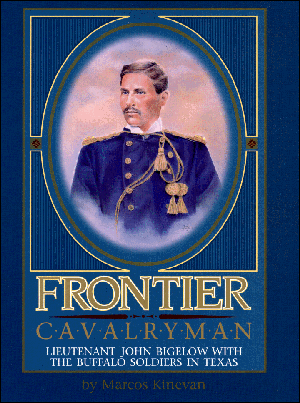
Marcos Kinevan's biography
of Lt. John Bigelow, Jr.
of the Tenth U.S. Cavalry
The Wonderful Country has a number of characters who serve in the Tenth U.S. Cavalry. The Tenth was famed for its African American "Buffalo" soldiers, and its exploits in fighting Indians, especially in Texas and then Arizona.

> See TSHA on Col. Benjamin H. Grierson

Less famous, but undeservedly so, is Lt. John Bigelow, Jr., who is the subject of a forthcoming paper I presented at last year's Center for Big Bend Studies Conference. His younger brother, Poultney Bigelow, who published his series of articles on trailing the Apaches, was a great friend of artist Frederic Remington who illustrated many of the articles. Their father, John Bigelow, was an accomplished editor (at one point editing the New York Times), he served as President Lincoln's ambassador to France, and had much to do with the founding of the Republican Party, the New York Public Library, the Panama Canal, and promoting Swedenborgianism. Bigelow, Sr also entertained literary celebrities including Charles Dickens and Oscar Wilde. My paper explores some of the family's rich and varied social and political connections, John Bigelow Jr's reports for Poultney's magazine, his role as a nexus between the Eastern establishment and the West, and his importance as a military intellectual who anticipated the profound changes to come in 20th century warfare.
> See my Notes on John Bigelow, Jr. and
> Further Notes on John Bigelow, Jr.


NOTES ON THE 1959 MOVIE "THE WONDERFUL COUNTRY" BASED ON THE NOVEL
... Reminds me of that old joke about the goats out browsing on a hill in Hollywood. They find the can with the reel of film, they kick it open, and they start munching... The one goat says to other, well, whaddya think? The other goat chews some more. "Eh," the goat says, "I liked the novel better."


One of the African American "Buffalo soldiers" is played by baseball star Satchel Paige. Tom Lea himself has a cameo as the barber, Peebles.


MORE ABOUT TOM LEA'S LIFE AND WORK

The go-to resource is the webpage for the Tom Lea Institute.

Tom Lea: An Oral History


Lea could be very self-depreciating. From Tom Lea: An Oral History:

"Writing is a kind of burden to me, which painting is not. I sweat and stew and fight painting, but I am not overwhelmed... by problems like I was with writing. I taught myself to write and never had any kind of a mentor or formal course... I taught myself to write by reading, reading good stuff."

On The Wonderful Country:

"...I wanted to do something that ad been on my mind since I was a kid: Write about this borderland and the people on both sides of the river."

"When traveling down in Mexico I never carried anything more than a little notebook because I was trying to train myself to hear rather than to see. I was trying so hard to be a good writer, you know... The hardest chapter in that book was where Martin goes with Joe Wakefield across the river in the springtime. I was trying to tell how much this fellow felt about both sides of the river. I remember I struggled and struggled for some way to express springtime and I settled it by saying, 'A mockingbird sang on a budded cottonwood' or something like that. I had to watch myself about using the big word. I always chose the shortest way if it could say exactly what I wanted."


NOTES ON CRAFT: SPECIFICITY

In my workshops I often discuss what it means to see as an artist and the importance of using specific details that appeal to the senses. Lea does this so beautifully. A few examples:

"A gust of wind sished sand against the one small windowpane." (p.16)
"They ate in the light of tallow dips, a dozen men in soggy leather, laughing and chewing, with the rain sounding on the roof, and cold drops leaking through." (p.250)
"Slowly, under the winking high stars, they came to where they saw beyond the paleness of the sand the darkness of the brush that lined the river, and they rode toward it. They worked across a dry flat of alkali white in the starlight, with the hooves scuffling the crust in the windless silence. " (p.306)


FURTHER MISC NOTES

From Tom Lea Month 2012, Nick Houser on Lea's Cabeza de Vaca picture


In my opinion, Lea's masterwork is his 1938 mural "The Pass of the North" which is in El Paso Historic Federal Courthouse Building.


NOTES ON HIS FAMILY

Lea's father was Tom Lea (1877-1945), who served as mayor of El Paso during the Mexican Revolution. (Alas, many Mexicans and Mexican Americans do not remember Mayor Lea fondly;  this is one reason why.)

A cousin was Homer Lea, an advisor to Sun Yat Sen.
> See Lawrence M. Kaplan's biography, Homer Lea: American Soldier of Fortune


> Your comments are always welcome. Write to me here.


Monday, April 16, 2018

Cyberflanerie: El Paso's Secret Tunnels, Gondek's Biography Podcast, Patricia Dubrava on Ursula Le Guin, Susan Coll's Trailer & etc.

El Paso's Secret Tunnels:

Chris Gondek's excellent Biography Podcast is now available on YouTube:


A most extraordinary trailer, for Susan Coll's comic novel The Stager:


Alright then! For Politico, Nicolas Carr explains Twitter

From one of my favorite blogs: Pat Dubrava celebrates Ursula Le Guin

Trailer for T.R. Hummer's After the Afterlife (Nietzsche will be mentioned.)

For my fellow Mexican history nerds: Maximilian's Memoirs (link goes to a post on my Second Empire / French Intervention blog)

Reb Livingston reads "That's Not Butter" (Reb! I miss your blog "Homeschooled by a Crackling Jackal.")

Barbara Allen Hosts Palo Alto's First Poetry Post

Click here, then scroll waaaaaaaaaaaaaay down, for the talk on "Robinson and Una Jeffers: A Life in Letters"

Ye oldie but yumsie by Dmitry Orlov, The Despotism of the Image

GIF: H?

> Your comments are always welcome. Write to me here.


Sunday, December 03, 2017

Waaaay Out to the Big Bend of Far West Texas, and a Note on El Paso's Elroy Bode

[ Dr. Cecilia Autrique at the Center for Big Bend Studies Conference,
Sul Ross State University, Alpine, Texas, November 2017
Her paper is
"American Protestants, Civil Society Organizations, and
Temperance on the US-Mexico Border, 1920-1930" ]
Earlier this month I traveled the loooooooong way out from Mexico City via Houston and then via El Paso to Alpine, TX-- (that latter stretch through the Far West Texas desert, spectacular though it be, not for the caffeine-deprived)-- to participate in the annual Center for Big Bend Studies (CBBS) conference at Sul Ross State University.

>>CONTINUE READING THIS POST ON THE NEW PLATFORM AT WWW.MADAM-MAYO.COM

I've been working on this book about Far West Texas, which includes the Big Bend, for an age & an eon, so last year, when I was invited to present at the 2016 CBBS conference, I was honored but flummoxed. My book hadn't-- and still hasn't-- been published and, anyway, it's not a scholarly work but, as I have begun describing it, a lyrical and personal portrait of place. No, no, what they wanted was for me to talk about my book published in 2014, Metaphysical Odyssey into the Mexican Revolution: Francisco I. Madero and His Secret Book, Spiritist Manual. I was flummoxed again, for that book about the book by the leader of Mexico's 1910 Revolution has zip to do with the Big Bend!

Well, it turned out that anything and everything about the Mexican Revolution is game for the CBBS conference, which is multidisciplinary and covers subjects relevant not only to the Big Bend but the surrounding regions, which include the Texas Panhandle, New Mexico, and northern Mexico's states of Chihuahua and Coahuila.

So last year at CBBS I presented Metaphysical Odyssey into the Mexican Revolution, and I came away mightily impressed-- so much so that I decided to present again this year and I recruited my amiga, Mexican historian Cecilia Autrique, to present her outstanding paper, "American Protestants, Civil Society Organizations, and Temperance on the US-Mexico Border, 1920-1930." (This paper stems from her PhD thesis at the UNAM in Mexico City, which I hope will be published as a book in both Spanish and English, for it provides vital historical context for any discussion of the current US-Mexico border and narcotrafficking issues.)

This year I presented my paper on "John Bigelow, Jr: Officer in the Tenth Cavalry, Military Intellectual, and Nexus Between West and East"-- much of which material will appear in my book in-progress, World Waiting for a Dream: A Turn in Far West Texas.

Look for the paper on my website shortly; in the meantime, for those interested, my blog posts about Bigelow are here and here, and the post about his brother, author, world-traveler, life-long friend to Kaiser Wilhelm II, and pioneer magazine publisher Poultney Bigelow, is here. And the selected bibliography on John Bigelow, Jr. and the Bigelow family, and related subjects, which I handed out at the conference, is here.

Bigelow's relevance to the Big Bend is direct: he was stationed there more than once, scouted all around the region, and indeed, he is an officer already well known to any and all who would study the Indian Wars and the Buffalo Soldiers. I trust I have been able to add new dimensions and insights to his importance for this region, and the West as a whole.


HIGHLIGHTS

One of the downsides of a bustling conference (indeed, a downside to just about everything nifty in the human experience) is that it is impossible to be in two places at the same time! It can also be a challenge to fit fascinating and vital conversations, such as they pop up, into the precise times allotted for coffee breaks and lunch. Alas, there were talks I am tremendously sorry to have missed or to have had to slink into half way through.

Just a few-- a very few-- of the highlights for me:

Felix Almaraz channeling a Franciscan missionary (and in costume!)

Lonn Taylor's talk about J.J. Kilpatrick of Candelaria, Texas (right on the Rio Grande) during the Mexican Revolution
This is a movie! (Or has it been made already? If not, por dios, ¿porqué no?)
> Check out Lonn Taylor's always fascinating "Rambling Boy" column for the Big Bend Sentinel, and my podcast interview with him, "Under Sleeping Lion: Lonn Taylor in Fort Davis"

Once again, Al González of Chiricuahua Books busted my shoe budget for the year. I took home a biography of Jack Hays and two very rare books by cowboys about Marfa, Texas.

Ayyy, and gigazoodles of postcards!

Steve Black
Who gave a super crunchy keynote
about Eagle Nest Canyon
A keynote speech by lead archaeologist Steve Black about Eagle Nest Canyon at Langtry, Texas
> One of the most jaw-dropping canyons in Texas. Check out my mini-video of the entrance of Eagle Nest Canyon from a visit a couple of years ago here.

(Perchance you wonder, did we see the Marfa Lights? Not this time. But I have indeed seen them and on four different occasions.)


AND A NOTE ON EL PASO'S ELROY BODE

As you might imagine, flying from Mexico City to El Paso via Houston, and back, apart from being a sardine-y experience, was the perfect opportunity to get some reading done.

I have belatedly discovered Elroy Bode!* Doubly belatedly, for Bode passed away only months ago. (See his obituary in the El Paso Times.)

*Pronounced Bo-dee.
I devoured Bode's El Paso Days and got started on In a Special Light. As the blurbs on his books attest, Bode is much-admired and even beloved by many Texan writers and readers of a literary bent, but he remains obscure, not only outside the region but, as my visit to El Paso's Barnes & Noble attests, even in his home town. (Nope, the Barnes & Noble did not have in-store even one copy of Elroy Bode's -- "who? Brady?"-- several books. But for, like, totally sure, they did have, for the man in front of me in the customer service line, Exploding Kittens.)

Poet Naomi Shihab Nye says:
"Elroy Bode is one of the most essential writers the state of Texas has ever been lucky enough to call its own. In a voice that is at once deeply descriptive and eloquently minimalist, he illuminates our corners, dim memories, streets, fields, prairies, hills, hours, and the hardest of days. His no-frills frankness and steady attentiveness have always had a radiant, carifying power."

As I read I tagged so many of Bode's lines but perhaps the best, most representative of all is this one, from "Earth-Life" in the collection of his poetic essays, In a Special Light:

"I need the El Paso countryside. I need to hear the call of redwing blackbirds from salt cedars along an Upper Valley canal. I need to stand in a pecan grove and feel the breeze that moves through it-- a breeze that reminds me of other breezes in other trees in other, almost forgotten times. I need to see stretched of plowed land where, in the distance, humans are reduced in scale and become of no greater importance to the eye than a rooster in a yard, a tractor in a field."

After the CBBS conference I spent an afternoon in the El Paso Public Library's Border Heritage archive where I looked up Elroy Bode and Amado Duro. More about those two caballeros literarios anon.

> Your comments are always welcome. Write to me here.


Monday, November 13, 2017

"Dear Mother, Am feeling fine, as hard as a rock and as brown as an Indian": More Postcards from the US-Mexico Border Circa 1916

It's a hazard in rare book nerderie: the ephemera bug bit me! I'm just back from the Center for Big Bend Studies Conference at Sul Ross State University in Alpine (Far West Texas), where I presented on "John Bigelow, Jr.," about which a longer post is forthcoming, but in the meantime, fresh from that book fair with its bodacious selection of ephemera, herewith, thanks to Galvan Creek Postcards, a few additions to my burgeoning collection of Texas postcards from the era of WWI and the Mexican Revolution:
>> CONTINUE READING THIS POST AT WWW.MADAM-MAYO.COM

"ARMY MANEUVERS ON THE MEXICAN BORDER"
Postmark:
MARFA, TEX
OCT 10
 2PM
1916

TEXT:
 hellow Jack
how are you I am fine & dandy.
Well I rec your letter
OK but I am still in the war
Well regards to all Your friend LB [?]

Jack Hendrix
Medicine Mound
Tex 
b
"BORDER DUTY ON THE RIO GRANDE"
(REVERSE BLANK)
"MOUNTED SCOUTS; THE WAGON TRAIN"
Postmark:
EL PASO, TEX
AUG 30
1916

TEXT:

Will write a latter lato
[? ? ?]

El Paso Texas
August 29, 1916
Dear Burt:
Rec you letter
and was glad to hear
from you they have everything
in the stores down here that
they have have in Mass but they have a
lot of Mexican things here that they
dont have in Mass we had Gov inspection
this morning but i passed alright the
[?] R F D got excellent love to all
Albert

Mrs Elmer Loving
Palmer Road
Halifax
Mass


"BOYS IN KAKHI GUARDING THE RIO GRANDE"


"W.H. HORNE CO. EL PASO, TEX. U.S. CAVALRY DRILL"


"FORT BLISS, TEXAS"


POSTMARK:
PHARR, TEX
SEPT 20
1916

Sept 19 '16
Dear Mother:
Am feeling fine
and as hard as a
rock and brown
as an Indian. Just
3 months ago tonight
we were called out
Remember? How
is every thing and
every one? L.A.B.

Mrs F.G. Ball
11489 N. Main
Jamestown,
N.Y.


> See also my previous post, Postcards from the US-Mexico Border of Yore.

P.S. My favorite rare book dealer blog is Greg Gibson's Bookman's Log. Watch out, these rare book and emphemera guys are dangerous. If he ever scares up a Manhattan clipper ship card...

> Your comments are always welcome. Write to me here.


Monday, January 23, 2017

A Visit to El Paso's "The Equestrian"

This finds me working on the book on Far West Texas, and about to resume the Marfa Mondays podcasts (20 podcasts posted so far, 4 more to go, listen in anytime). I just posted a brief video of my visit last November to see, among other wonders and curiosities, a most extraordinary and controversial statue at the El Paso International Airport. 

Because of the way it is placed, directly behind a grove of extra-fluffy trees, and at the entrance where most drivers, speeding in, are on the lookout for signs, such as rental car return, departures, arrivals or parking, I daresay few passersby would even notice the statue. I myself drove by it more times that I would like to admit before I realized it was there.

[>>CONTINUE READING THIS POST AT WWW.MADAM-MAYO.COM]

Here's my 3 minute video:


My video mentions "The Last Conquistador," a magnificent documentary about this statue and the controversy. Watch the trailer:


POV Interactive offers the first clip of "The Last Conquistador" documentary:


For "Behind the Lens POV PBS"
Cristina Ibarra and John Valadez Talk about the Juan de Oñate Sculpture:


I'll give the sculptor, John Sherrill Houser, the last word, quoting him from the documentary:


"Here it is, look at this and think about it, good and bad, the whole thing. The history."

Update: Houser passed away in 2018. Read his obituary here.

> Your comments are ever and always most welcome. Write to me here.


Monday, March 07, 2016

More Translating Beyond Borders: BorderSenses Fall 2015 issue with Agustín Cadena's "Blind Woman"

El Paso on my mind... I just received my gorgeous Fall 2015 issue of the El Paso-based literary journal, BorderSenses, which includes my translation of a poem by Mexican poet Agustín Cadena, "Blind Woman" ("La ciega.") Also in this beautiful issue is a poem by none other than Diana Anhalt.


BLIND WOMAN
By Agustin Cadena, Translated by C.M. Mayo
(Bordersenses, Fall 2015)

With its fingernails, shadow 
peeled away reality.
Like a doll's skin,
the world, the other world,
came apart.
      Only this which is true
remained visible.
She seems to contemplate something and, maybe,
with her soul, she does contemplate.
      In the sky of her eyes
the wind of desire stirs,
blurs these clouds of hers.


> For those of you read Spanish, check out Cadena's blog El vino y la hiel. 

> Plus: read my translation of his short story "Lady of the Seas" in my anthology Mexico: A Traveler's Literary Companion. 

> Extra plus plus: my dear amiga Patricia Dubrava also translates Cadena. Check out her blog post about him here. 

Agustín Cadena is one of Mexico's literary treasures. I am very proud to say that he is also my translator (of my most recent book, and others), and his translation of my essay "A Visit to Swan House" appears in this month's issue of Letras Libres. (More about that anon.)

> Listen in anytime to my reading of another translation of one of Cadena's poems, "Café San Martin," from Sarah Cortez's anthology, Goodbye Mexico, here.

> An age ago, BorderSenses published one of my wiggier poems, "Man High," which you can read online here. (Nope, it's not about dope.)

> More about my translations of Mexican poetry and fiction of Agustín Cadena, Mónica Lavín, Araceli Ardón, Rose Mary Salum and Ignacio Solares, among others, here. 
[Fall 2015 issue of BorderSenses]

Well, I may be slower than a tortoise on a glacier with "Marfa Mondays," the 24 podcast series apropos of my book in-progress, but I am moving forward with podcast #21, which goes to Bracketville, Texas (a scooch east of the Pecos) and is about one of the most unusual communities anywhere, and its unique association whose members have worked to preserve stories of the ancestors, stories that have no more apt adjective than Biblical. Stay tuned. Meanwhile, listen in here anytime to the other 20 podcasts posted to date.


(University of Texas El Paso Centennial Lecture 2015)


> Your comments are always welcome. Write to me here.

Monday, February 15, 2016

Blood Over Salt in Borderlands Texas: Q & A with Paul Cool about SALT WARRIORS

I'm still turtling along in writing my book about Far West Texas, which has involved not only extensive travel in the Trans-Pecos and some podcasting but reading-- towers of books!-- and what a joy it was to encounter one so fascinating as Paul Cool's Salt Warriors: Insurgency on the Rio Grande. 

A meticulously researched and expertly told history of the El Paso Salt War of 1877, Salt Warriors is essential reading for anyone interested in US-Mexico border and Texas history, and indeed, anyone interested in US history per se.

The El Paso Salt War of 1877 was sparked by "Anglo" businessmen staking claim to the massive salt bed that lies just west of what is now the Guadalupe Mountains National Park. Local Mexican-Americans, known as Paseños, considered the salt deposits community property, in accord with Spanish Law.

[>>CONTINUE READING THIS POST AT WWW.MADAM-MAYO.COM]

While the salt may have been free to anyone who would shovel it up, that required an arduous journey across the desert with carts pulled by oxen, and under constant threat of Indian attack. For Paseño farmers who eked out a living in this drought-prone region, the salt they could harvest was vital for curing food, pelts, for livestock licks, and above all, as a cash commodity-- much of it sold to mines in Mexico, where it was used for refining silver. The Paseños were outraged when Judge Charles H. Howard, a recent arrival from Virginia, informed them that they would have to start paying his father-in-law, a German businessman based in Austin, for the salt.


[Photo I took through the windshield,
approaching Guadalupe Mountains National Park
from highway US 62, which goes through the salt lake.]

In the wake of the El Paso Salt War, several people on both sides of the conflict had been killed, some horribly (Judge Howard was murdered, and his body mutilated and thrown down a well), the town of San Elizario sacked, several reputations ruined-- some fairly and others unfairly, as Cool argues-- and a wedge of suspicion and resentment driven between communities that is still, more than a century later, not entirely healed. 

Paul Cool is a former Army Reserve officer and resident of Arizona with an avid interest in the US-Mexico borderlands. He kindly agreed to answer my questions via email. 


C.M. Mayo: When and why did you develop your avid interest in the US-Mexico border?

Paul Cool: It came late in life, but traces back to growing up in Southern California and marrying a young lady whose paternal grandparents came to El Paso during the Mexican Revolution. Unfortunately, I spent nearly two decades trying to write a book about the French Revolutionary/Napoleonic era, and only recently turned to the borderlands for material.

C.M. Mayo: What prompted your interest in the Salt War?


Paul Cool: I have always been drawn to historical eras marked by the collapse or relative absence of order, justice, and social restraint, periods when ambitious or unscrupulous individuals are more able to give free rein to their personal desires and vices at the expense of the larger community. The late Roman Republic. Revolutionary France. The frontier West.  

In 1999, I drove from Seattle to Baltimore via El Paso, where I happened to purchase Walter Prescott Webb’s history of the Texas Rangers. His book contains a chapter on the Salt War. It was obvious there was an interesting story here, but it was buried beneath the ethnic bigotry running through Webb’s take. I then read C. L. Sonnichsen’s little book on the Salt War. The writing was vivid, and his account grabbed me in a way Webb’s had not. I felt closer to what happened, but the characters were still archetypes and stereotypes.

C.M. Mayo: Outside the region this conflict is almost unknown. Why do you think this is? 


Paul Cool: Several reasons. The Spanish-speaking losers in the conflict disappeared into Mexico, and were in no position to write the history. As for the Anglos, many of the protagonists died, and they were soon replaced as by others who came to El Paso with the railroad, lacking any concern for the past. The story was buried because it was about a world that no longer existed, and no one cared about. 

Second, the story did survive as a chapter in Texas Ranger history, but since the Rangers surrendered to an enemy repeatedly characterized as a “howling mob,” Texans generally considered the Ranger performance a thing of shame and no one made any effort to expand our knowledge of the episode for that reason.

Third, from the perspective of Anglo sources, no iconic Anglo figure arose to grab our attention and turn the story into the stuff of legend north of the border. I think the 1916-1918 Arab Revolt illustrates what can happen with a hero. Think of Lawrence of Arabia’s impact on Western understanding of the Arab Revolt. Without Lawrence, no newspaper coverage by Lowell Thomas, no Seven Pillars of Wisdom, no David Lean film, no Omar Sharif as Ali or Zhivago! Lawrence's story, and all that followed, is a misreading, to be sure, but corrective history is now available. It is possible that Mexican sources will reveal the existence of a hero, possibly Barela, possibly someone who we don’t yet know, and the information needed to provide the foundation of a heroic narrative. The romantic in me hopes that further research uncovers such a figure who can raise awareness of this popular yet tragic rebellion, south of the border first, then migrating up here.

Latino historians are and have long been aware of the Salt War and its place in Mexican American history. When I asked Dr. Arnoldo De Leon, a preeminent authority on Tejano history, why Latino scholars had never tackled the subject, he explained that they are playing catch-up, that there are so many stories still in need of telling, so many that continue to wait their chance.

C.M. Mayo: Of the results of the war, you write (p. 4) "In the long term, the distrust and marginalization of Paseño citizens by Anglos was deepened." Your book does an excellent job of showing why this was but at the same time, you show that the insurgency was not "a bloody riot by a howling mob but in reality a complex political, social, and military struggle." After your book came out, did your argument meet any notable resistance?


Paul Cool: The academic community has generally applauded the appearance of Salt Warriors, although some reservations about my approach have been expressed. For example, one reviewer justly criticized the book for its reliance on north-of-the-border sources, to the exclusion of any archival material inside Mexico. I do not speak or read Spanish, and did not have the resources to hire others to dig through material that might or might not tell the story I wanted to tell. I had a choice: I could leave the story untold because I could not do a so-called “definitive” version (which is always elusive anyway), or I could tell this story to the best of my ability and hope that others would follow up to provide new perspectives. 

One other criticism I will mention is that I gave my opinion of the key participants, of their individual responsibility for the chaos and destruction that took place, and even of their moral failings. Some said that is not the historian’s job. It is best to just state the facts and let the reader decide. That may be true, but in this case, I felt that the story of the Salt War had been so repeatedly twisted over time that a clear statement of who was responsible was in order. One can never really know the hearts and minds of people who died more than a century before, but I feel confident in my opinion of who was most responsible for the tragedy.

C.M. Mayo: What lessons does the Salt War offer us today? I am thinking of some of the dynamics we see played out with other insurgencies and their repression, and the dynamics that ensure. On p. 235 you write "'Throughout history,' today's U.S. Army and Marine Corps officers learn, many defeated insurgent movements 'have degenerated into criminality.'" My understanding is that this would apply both to some of the defeated Mexican-American and allied Mexican insurgents, as well as to many ex-Confederates who were then coming into the Southwest and taking up careers as rustlers, and bank and train robbers.

Paul Cool: Any population is always going to include “hustling individualists” who are most interested in getting what they want, whether it is inordinate power or wealth at the expense of the larger population, or the satisfaction of some baser need, including taking something from someone else in a violent or disturbing manner. 

The question is, does the presence of an equally applied law and a just order prevent or at least put a damper on that? 

In the first instance, one group, whether it's Gilded Age entrepreneurs and their political allies, or their 21st century heirs on Wall Street and in government, uses “law” to corral wealth and power at the expense of the general population. 

In the second, violent criminals trade on the lack of “order” to achieve much the same ends, perhaps more bloodily, but not necessarily on a smaller scale. 

What transpired in post-Salt War El Paso, in terms of increases in criminal activity by gangs and individuals, was probably not much different in nature than what happens any place the authority structure collapses, whether in Iraq, Revolutionary France between Louis XVI and Napoleon, or the Soviet Union after Gorbachev. 

But something additional happened in El Paso, new to the American West but not uncommon in world history. There, the sheriff hired mercenaries to enforce order against perceived enemies, in this case the Mexican American population. Those mercenaries included career criminals led by John Kinney. What happened in El Paso became, for a few years, the way sheriffs did business in the American borderlands, and was repeated during the Lincoln County War (again with Kinney leading a band of criminals) and in Cochise County, Arizona during the final stage of the so-called Earp-Cowboy troubles. 

C.M. Mayo: You were a former Army Reserve officer. How did this inform and color how you saw some of the individuals in this story?

Paul Cool: The event had largely been treated as an ugly civil disturbance requiring military policing. I decided to approach it as a “war” brought on by clashing cultures, economic drivers, and untrammeled ambition. 

My own military career was slender, but my first thirty years were spent as the son of a decorated combat hero and, as a Reserve officer, in close association with officers and men who also met that definition. The military is made up of people from the general population. Soldiers, sailors, and airmen are, in that sense, much like the rest of us. But in addition to military knowledge, i.e., how to fight and win, the military honestly attempts to inculcate certain ideal qualities, including honor, integrity, reliability. People, whether the population you’re sworn to protect or your buddy in the next foxhole, suffer and die unnecessarily when these qualities are forgotten or ignored. The military I knew does try to adhere to them.  

There is, of course, so much more to the military ethos, but I mention these factors because they influenced the course of the Salt War. There were army officers, such as Lieutenant Rucker and Colonel Hatch, who attempted to use their influence and authority to prevent violence and to quickly, peacefully put a lid on it. But it just so happened that, at the critical point, the officer on the scene, Captain Thomas Blair, possessed probably less integrity than any other officer in the U.S. Army. He was a smooth charmer, and no one realized his lack of character. Had Rucker not been replaced by Blair, or had Blair possessed ordinary integrity, it seems to me likely that some of the violence might have been short-circuited. Who knows? It was only later, through Blair’s bigamy, that the value of his word was revealed to all.

The military also attempts to instill discipline, to convince young soldiers to follow the rules, something that goes against the grain for many, from teenagers to independent-minded middle-age men. Discipline enables a unit to carry out its missions and prevents the naked exercise of power in service to personal wants. The Salt War illustrates the importance of discipline and leadership. We read that the various companies of the Ninth Cavalry occupying the Mexicano towns carried out their pacifying mission without any complaints, whereas soldiers from the company of the Tenth Cavalry engaged in a variety of violent personal and property crimes. The difference was the discipline instilled by the leaders of the Ninth Cavalry, but not the Tenth, both prior to and during the military action. 

C.M. Mayo: A modern recounting of the Salt Wars usually makes Judge Charles H. Howard into a simple character, an arrogant, stubborn and greedy villain, the outsider who swiped the community's salt and then, even to the point of endangering both himself and others, insisted on pressing his client's claim. One of the things I appreciated about your book is that you explained in more depth some of Howard's probable motivations and, in particular, the mid-19th century Virginian concepts of honor to which he would have ascribed. The fact that he was bereaved after the death of his wife and deeply indebted to his father-in-law, the purported owner of the salt lakes, was another crucial factor you point out. 

It seems to me that you have made a powerful effort to objectively present the different points of view in the conflict. Was this something that came easily or did it take a while? 


Were there any individuals whose motivations were particularly obscure to you, or even now remain so?


Paul Cool: While I don’t subscribe to the “great man” theory of history, I do believe that individuals make a difference, whether it’s Jean-Paul Marat steering the French Revolution along a more violent course or young Charlotte Corday who feels bound to save France from Marat. I believe that the Salt War was filled with such characters, whose personalities and behaviors were instrumental in leading the county into a downward spiral. That was not fully evident from the published record, because Salt War history was for decades largely a matter of historians regurgitating the same tale: largely nameless, faceless, hapless Texas Rangers surrender to a Mexican mob led by the evil Chico Barela. Nothing worth investigating further. But once I dug into sources not previously used, such as the federal government’s records, or personal correspondence that popped up in newspapers or located in the governor’s records, a different story emerged. At some point, for some reason, I decided to investigate the lives of key players before and after the Salt War. And that’s where I found the keys to their actions in 1877, most notably in the cases of Blair and Kerber.

Howard is a figure out of Greek tragedy. He wore his arrogance on his sleeve, but arrogance is a trait, not a motive. What was his motive? What impelled him to send a county over a cliff? It had to be something deep and personal. Howard himself spoke and wrote of his debasement by the Paseños, of his overriding debt to his father in law, of his depression after the loss of his wife. Losing his honor, he wanted only to regain it, and it did not matter who he harmed in the process. He was raised in a society that educated him to believe that personal honor trumped all.  I don’t believe that he saw that he had any choice. He could only act as he did. 

That realization took me some time to reach, and it came by happenstance. I caught an interview with Dr. Joanne Freeman, who wrote a book on the highly ritualized duels in the early Republic. (Think Hamilton and Burr.) She stated that, as the 19th century progressed, the formalities fell away, and those who felt their honor attacked were far more likely to just start shooting and caning one another. I thought she was describing Howard feeling empowered to beat or kill Cardis on sight. That led me to some readings on ante-bellum notions of honor and shame, and to discussions with Dr. Gary L. Roberts, who has written about codes of honor in the South and West.

I am afraid that, despite the best efforts of New Mexico historian, Dr. Rick Hendricks, I never quite got a handle on Father Antonio Severo Borrajo, the man most demonized by contemporary Anglo sources. Toward the end of my work, I did add a paragraph that attempted to make sense of Father Borrajo, based on Dr. Hendrick’s guidance, but then in the final flurry of chopping and editing the manuscript, the passage got deleted from one spot and not replaced in another. I didn’t notice until the book was published. I tell myself that these things happen, but it’s a mistake I’d rather sweep under the rug. I’d love to revise Salt Warriors after Dr. Hendricks publishes his Borrajo biography. I think that would fill a large gap in the story I’ve told.

The Paseños were a tough nut to crack. They did not write the histories, their thoughts are largely absent from the written record, and the victors universally denigrated their motives and characters. I got past that in two ways. First, I decided to make the Paseño community a character.  Who were these people at the Pass of the North? Faced with a century-long relative isolation from Spanish, Mexican, and American authorities and support systems, what kind of community did they establish and build? How did it function? What did that maintenance and development of a community say about its leadership? Guesswork on my part was necessary, but traits did present themselves and a portrait I trust did emerge. 

Second, in the case of the Paseno’s leaders, I was able to draw conclusions about their leadership skills based on their military actions, which were quite elaborate. One thing that the evidence revealed is that the Paseños had a long history of self-defense, whether against Apache raiders or the demoralized Confederates who retreated from New Mexico. It was obvious that the Paseño community had a core of leaders they turned to, men who had previously considered how best to respond to threats, and had put their lives on the line to lead those efforts. I had no direct evidence enabling me to get inside the minds of Chico Barela (or “Varela”), Sisto Salcido, or other leaders, but the reports of what actions they took was very revealing. For example, the traditional Anglo account is that Barela was a man not given to keeping his word. A different reading is that he was a master of using deception to misdirect his enemy’s attentions and actions. He could spot an opponent of weak resolve and then guide his actions by telling that opponent what he wanted to hear. He played his opponents no less than Napoleon, Robert E. Lee, or Rommel. That’s something you do in war, if you can. Ultimately, Barela and his little army bit off more than they could chew, but they conducted a skillful military operation that achieved short-term results no one among the Anglos expected.

C.M. Mayo: About Father Antonio Severo Borrajo, who as you say was "most demonized by contemporary Anglo sources," would you like to share the lost paragraph?

Paul Cool: Unfortunately, whatever paragraph I had on Borrajo was in some unknown spot in some unknown draft that never got indexed. However, whatever I put in was influenced by this 2002 corrective view by Dr. Hendricks, who, since 2010, has been New Mexico's State Historian. I do think Borrajo's intolerance of the Protestants and the French-based Catholic teachings of the then current parish priest, Father Pierre Bourgade (later archbishop of Tucson), helped to keep the population stirred up, even if he was not the greedy demon falsely portrayed by his enemies. Unfortunately, Borrajo's appearances during 1877, the climax of the crisis, are few and references to him at that point are probably less reliable than usual. 

C.M. Mayo: Louis Cardis, the Italian-born businessman and stagecoach owner is a most intriguing character. Was it possible to find out more about his origins other than that he was from Piedmont and might have served as a captain in Giuseppe Garibaldi's army? 

Paul Cool: There was more about his life story and others that just had to come out to get the book down to size. Anything I found that explains his actions did stay in the book. He is another character who, where the written record is concerned, is largely seen through the eyes of others. I detect no bigotry toward his constituents, none, but he did not do all he could to protect them from the power structure that was moving to seize their grandfathered rights in the salt lakes. For example, he signed his name to the 1876 Texas Constitution that enabled private citizens to own saline deposits, but never after, as far as I can tell, spurred his constituents to take legal action to forestall Anglo ownership. 

C.M. Mayo: As you proceeded with your research, what most surprised you?


Paul Cool: This project started as a planned 2-3 chapters in another book. I was surprised by the complexity and the epic sweep of the story, and by the characters who could leap off the page in the hands of writers much better than me. (If there were a viable market, this story deserves a ten-hour TV miniseries starring Russell Crowe and Edward James Olmos, among others.) If I could have made Salt Warriors twice as long, I would have. Pity the poor reader had I owned my own publishing house. 

C.M. Mayo: You were able to talk to several of the descendants on both sides of the conflict. Were you surprised by how they saw it?


Paul Cool: The families that remain in San Elizario knew they had reason to be proud of their ancestors, but over the years, exposed only to increasingly vague oral tradition and the Anglo-centric writings of later historians, they had largely lost the details of what really happened. In some cases, I had to reject the tradition, but in other instances, I thought tradition held up and explained what the records obscured. It was the first time I had to make sense of oral tradition, to treat it as evidence that deserved to be weighed rather than ignored.

On an early visit to San Elizario, a leader of the local historical and genealogical society showed me where tradition said certain key events happened. My research often showed otherwise, and a few years later I was happy to return the favor, incorporating the written evidence. We still had doubts about this and that event and had a great time trying to make sense of the surviving evidence, including tradition.

C.M. Mayo: In reading about the organized crime in El Paso in the wake of the Salt War-- in particular of cattle rustler John Kinney and his alliance with Sheriff Kerber-- it's tempting to make modern day comparisons with modern day drug trafficking, etc. Would you? Or was it something very different?


Paul Cool: Well, it was much, much, less organized, and the crimes much more impromptu than we see with modern drug traffickers. My subsequent research has led me to believe that a better analogy would be the Bahamian pirates of the early 18th century, those who established a base of operations on Nassau temporarily free of British authority. (El Paso had a government, but totally ineffective keeping order.) There were criminal leaders (Blackbeard, for example), but individual pirates were more or less free to sign on to this piratical raid or that. They had to strictly follow orders during any voyage—at sea, everyone’s life depends on it—but otherwise were independent contractors who, between “jobs,” had no duty to follow anyone.  Likewise, men might follow Kinney or not. That they raided with Kinney today did not prevent them from riding off to commit their own crimes tomorrow, or just sit around playing cards and drinking rot-gut till they went broke.

C.M. Mayo: One of the most astonishing things to me about the entire episode is that nearing the end of the book (p.280) we learn that the government never granted Zimpleman ownership of the salt lakes! So what happened after that? Who took possession of them? Who owns them now?


Paul Cool: I too was astonished by that. I did learn that some business did extract salt into the 20th century, but more than that could not tell you. I simply had to move on.

C.M. Mayo: Anyone who drives east out of El Paso en route to Carlsbad NM passes right through the salt lakes. But to really see them, what is the best place to view them? 


Paul Cool: If one is simply traveling east or west, on the way to or from El Paso, one can get a good view at several points along Highway 62/180.  My book’s cover painting, by artist Bob Boze Bell, is based on a photograph (found inside on the page facing the Introduction) that I took from this highway. A more immersive experience can be gained at the Gypsum Salt Dunes inside Guadalupe Mountains National Park. The lakes stretch for 100 miles, so I imagine there are any number of good sites for viewing.

C.M. Mayo: One of the stops on one of the routes from the Rio Grande out to the salt lakes is Hueco Tanks, an oasis with some important rock art that is now a State Park and Historic Site. For anyone interested in the history of the Salt War, is there any place there that would be especially relevant to see?


Paul Cool: Among the signatures carved into the rocks of Hueco Tanks is that of Santiago Cooper, one of the Texas Rangers who survived the siege and battle of San Elizario. 

A walking tour of San Elizario is essential. Many of the buildings date from 1877 and before. With the benefit of the bird’s eye view painting in my book, it is possible to follow the course of the actual fighting, as well as place other events that took place in town. A walking tour guide is also available at the museum, giving historic and architectural details on surviving structures.  

In the city of El Paso, a very few buildings survive, most notably the Magoffin House. One should also visit nearby Mesilla, New Mexico, near Las Cruces, where A. J. Fountain published the newspaper that gave the fullest, if one-sided, reporting of the events inside El Paso County. The town square dates from before the salt war.


C.M. Mayo: Anything else you think I should have asked?

Paul Cool: There was one other sound criticism of my book that deserves comment. In part because I did not use Mexican sources, I did not link the Paseños to Mexican national thinking and traditions regarding liberty, property, justice, and the right to rise in defense of one’s rights. Instead, I quite clearly linked them to traditions of New England’s minute men and the adoption of the U.S. Constitution. 
I did that for two reasons. First, I know more about U.S. traditions, and can stand on more solid ground. Second, I intentionally attempted to make a point to an American audience.  The political philosophy driving the Paseños was of a universal nature but could be and was expressed at the time by them (page 141) in terms that New Englanders of 1775, Continental Congress delegates of 1789, and the Anglos who moved to El Paso could understand, had their minds been open. However much the Paseños acted within the traditions of the long Mexican quest for justice within the law, they certainly acted within the U.S. tradition.

> Visit Paul Cool's website here.

> Your comments are always welcome. Write to me here.


UPDATES: Paul Cool passed away suddenly a few months after this interview was posted. See Mark Boardman's "The Coolest Guy in the Room, Paul Cool 1950-2016" in True West magazine, October 5, 2016.
For more about the area, see also Joe Holley's article, which mentions Paul Cool's work, "Danger Lurks in Salt Flats, As It Did A Century Ago," Houston Chronicle, August 26, 2016.


+ + + + + + + + + + + + + 

A note about the Marfa Mondays Podcasting Project: Exploring Marfa, Texas & Environs in 24 Podcasts. Twenty podcasts have been posted, most recently, an interview with Raymond Caballero about Mexican revolutionary General Pascual Orozco and Far West Texas. The remaining four have been scheduled. Stay tuned for podcast #21, which will be about the Seminole Negro Indian Scouts; 22, about Sanderson; 23 about María de Agreda; and the final podcast, #24, back to Marfa.