For anything to do with media, Marshall McLuhan is your superstar go-to guy. He's wild, brilliant, cryptic until you realize just how very brilliantly inside-out brilliant, and spookily prophetic. His famous saying was, "the medium is the message." His arguably most famous book, however, is titled The Medium is the Massage. An excellent introduction to his work is this video on the Marshall McLuhan Speaks website. It opens with his cameo in the Woody Allen film, "Annie Hall," then goes to an approximately 20 minute introduction by Tom Wolf.
> Listen in to Terrance McKenna on Marshall McLuhan for another richly interesting, yea verily, psychedelic introduction.
> For an official biography see the Marshall McLuhan official website. This official webpage includes the head-shaking "McLuhanisms."
@mmreadsbooks is of notes by McLuhan found by grandson
Andrew as he took inventory of McLuhan's working library
(Hmmm this note reminds me of reading Thundersticks...)
This year I've been posting a Q & A with a fellow writer on the fourth Monday of the month, and while I have every intention of continuing to do so, this Monday instead herewith some notes on the epic novel by the artist who, back in 2001, passed over to the Great Beyond: Tom Lea.
"It is part and parcel of your culture and I think you should cherish it," says Italian art historian Luciano Cheles of the surprisingly little-known works of El Paso, Texas painter and writer Tom Lea. And encouraging that is precisely what Adair Margo has been doing with great verve for the past many years with the website and educational programs of the Tom Lea Institute. I had the immense privilege of attending Margo's talk about Tom Lea at the Bullock Museum in Austin back on October 15, 2015. (And by felicitous happenstance, I sat next to Luciano Cheles.) More about that anon.
Here is the must-see 5 minute video with what Cheles has to say about Lea's artwork:
For more on Lea's and The Wonderful Country's place in the canon, see Marcia Hatfield Daudistel's majestic anthology, Literary El Paso (TCU Press, 2009).
Get the TCU Press paperback edition
from Seminary Coop et al
WILDEST WEST EL PASO
This post is prompted by my work-in-progress about Far West Texas (...stay tuned for more podcasts...) At long, belated last I have tackled Tom Lea's epic historical novel of El Paso.
I am happy to report that The Wonderful Country is wonderful indeed, a masterpiece not only of works set in El Paso, but in the genre of the Western, and indeed in all of American fiction.
These days most literary readers, and especially those out on the coasts, tend to turn their noses up at Westerns. Dear curious and adventurous reader, if that describes you, be assured that to overlook reading The Wonderful Country is to miss out on something very fine in U.S. literary heritage. The Wonderful Country was popular in its day, back in the 1950s, but it is not a typical commercial novel; it has a high order of literary quality; morever, its treatment of Mexicans and Mexico is unusually knowing and sensitive. (What would I know about that? Start here and here; my books are all here).
Set in post-Civil War El Paso, that is, the latter part of the nineteenth century, the first days of the railroad and the last of the free-roaming Apache, and published in the pre-Civil Rights era, Lea's The Wonderful Country forthrightly portrays many of the still painful tensions in the border region. While he writes with an unusually open heart and mind, Lea is scrupulous in rendering accurate period detail. The "N" word appears! (In the mouth of a character.) There is no lack of roastin' 'n stabbin' n' shootin' n' scalpin' and our hero is the son of a Confederate from Missouri. Vegetarians and those with flea-trigger hot-buttons, be forewarned.
From the catalog copy, TCU Press, 2002:
"Tom Lea's The Wonderful Country opens as mejicano pistolero Martín Bredi is returning to El Puerto [El Paso] after a fourteen-year absence. Bredi carries a gun for the Chihuahuan war lord Cipriano Castro and is on Castro's business in Texas. Bredi fears he will be arrested for murder once he is back across the Rio Grande. Fourteen years earlier-- shortly after the end of the Civil War--when he was the boy Martin Brady, he killed the man who murdered his father and fled to Mexico where he became Martín Bredi.
"Back in Texas, other misfortunes occur to Brady. First he breaks a leg; then he falls in love with a married woman while recuperating; and, finally, to right another wrong, he kills a man.
"When Brady / Bredi returns to Mexico, the Castros distrust him as an American, and Martin is in the intolerable position of being not a man of two countries but a man without a country.
"The Wonderful Country is marvelous in its depiction of life along the Texas/Mexico border of a century-and-a-half ago. Lea brings to life a time that was wild, a time when Texas and Mexico were being settled and tamed. Lea knows the desert region of his birth as well as anyone who has ever written about El Paso and the great nation that borders it to the south."
NOTES ON THE TCU PRESS EDITION WITH AN AFTERWORD BY JOHN O. WEST
You should be able to scare up a first edition over on www.abebooks.com, and power to you if you want to shell out the clams for a fine first with intact dustjacket and an autograph. The copy I read is the paperback reprint of 2002 available from TCU Press (and most online booksellers) which includes afterword by John O. West, a noted US-Mexico border scholar. For West's afterword I would recommend the TCU Press paperback as your best buy (unless your main goal, buck for buck, is to beat the stock market).
As far as I know, all editions include the elegant and evocative drawings Lea made to head each chapter.
John O. West argues, and I concur:
"The story of Martin Brady is that of Thomas Wolf's You Can't Go Home Again, of Mark Twain's Huckleberry Finn; the setting in the desert Southwest gives it particular realism, but the theme makes it speak beyond the region where it grew."
West also provides some illuminating background on the inspirations for the novel. My additional notes below.
NOTES ON THE PLACE, THE PEOPLE, AND THE EVENTS THAT INSPIRED THE NOVEL, PLUS SOME RELATED RECENT WORKS & WEBSITES
Tom Lea's "El Puerto" is based on El Paso; Fort Jefflin, clearly inspired by Fort Bliss.
The 1962 edition of WW Mill's Forty Years at El Paso illustrated
by Tom Lea is now a collector's item
Try abebooks.com
El Paso pioneer W.W. Mill's memoir Forty Years at El Paso, 1858-1898 was Tom Lea's major inspiration. A first edition is pricey! But it is out-of-copyright now so you can read a digitalized edition for free online.
W. H. Timmons' El Paso: A Borderlands History (Texas Western Press, 1990). Back in the 1960s, Timmons served as Chairman of the History Department at the University of Texas El Paso.
> Fort Bliss official website
Fort Bliss actually moved around the El Paso region quite a bit in the 19th century, but you can visit the current Fort Bliss, which has an adobe museum and a modern museum-- the latter perhaps of most interest for WWII aficionados. The historic parade grounds, surrounded by stately houses for senior officers, are well worth a visit.
Some of the characters in The Wonderful Country are inspired by (or mighty similar to) some real people, among them:
Both the U.S. Army and the Mexican Army went after the Apaches, and in some instances, U.S. forces chased Apaches into Mexico. In general such US Army forays seem to have been welcomed by the Mexicans, but communications in these remote areas were dicey and resentments still very raw after the US-Mexican War. Many historians writing in English about border history have not had the wherewithall to research Spanish language sources, and vice versa, so there is some low-hanging fruit here for those historians with cross-border cultural and language skills. The Apaches also have something to say about it. One recent biography of note is Kathleen P. Chamberlain's Victorio: Apache Warrior and Chief (University of Oklahoma Press, 2007).
Post-Civil War El Paso politics were brutal and bloody; Lea's novel does not exaggerate. In addition to W.W. Mill's Forty Years in El Paso, see Paul Cool's recent and excellent book about the El Paso Salt Wars, Salt Warriors.
The hero of The Wonderful Country becomes a Texas Ranger. A crucial source for Lea, writing back in the 1950s, was James B. Gillett's 1921 memoir, Six Years with the Texas Rangers: 1875-1881, from which Lea takes the epigraph and his title:
"Oh, how I wish I had the power to describe the wonderful country as I saw it then."
> Check out Gilett's page at the Texas Rangers Hall of Fame and Museum in Waco, Texas. Gillett ranched south of Alpine and upon moving to Marfa helped found the West Texas Historical Association. He died in 1937 and is buried in Marfa.
(The Texas Rangers made up a more heterogeneous group than some too easily conclude. See also the 2014 book by historian Cynthia Leal Massey, Death of a Texas Ranger. An interview with Massey is here.)
TENTH UNITED STATES CAVALRY
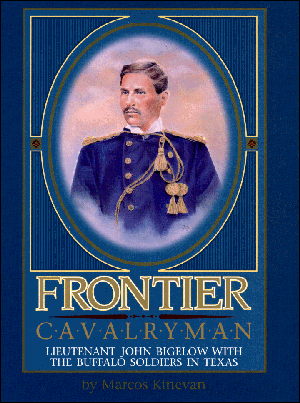
Marcos Kinevan's biography
of Lt. John Bigelow, Jr.
of the Tenth U.S. Cavalry
The Wonderful Country has a number of characters who serve in the Tenth U.S. Cavalry. The Tenth was famed for its African American "Buffalo" soldiers, and its exploits in fighting Indians, especially in Texas and then Arizona.
Less famous, but undeservedly so, is Lt. John Bigelow, Jr., who is the subject of a forthcoming paper I presented at last year's Center for Big Bend Studies Conference. His younger brother, Poultney Bigelow, who published his series of articles on trailing the Apaches, was a great friend of artist Frederic Remington who illustrated many of the articles. Their father, John Bigelow, was an accomplished editor (at one point editing the New York Times), he served as President Lincoln's ambassador to France, and had much to do with the founding of the Republican Party, the New York Public Library, the Panama Canal, and promoting Swedenborgianism. Bigelow, Sr also entertained literary celebrities including Charles Dickens and Oscar Wilde. My paper explores some of the family's rich and varied social and political connections, John Bigelow Jr's reports for Poultney's magazine, his role as a nexus between the Eastern establishment and the West, and his importance as a military intellectual who anticipated the profound changes to come in 20th century warfare.
> See my Notes on John Bigelow, Jr. and
> Further Notes on John Bigelow, Jr.
NOTES ON THE 1959 MOVIE "THE WONDERFUL COUNTRY" BASED ON THE NOVEL
... Reminds me of that old joke about the goats out browsing on a hill in Hollywood. They find the can with the reel of film, they kick it open, and they start munching... The one goat says to other, well, whaddya think? The other goat chews some more. "Eh," the goat says, "I liked the novel better."
One of the African American "Buffalo soldiers" is played by baseball star Satchel Paige. Tom Lea himself has a cameo as the barber, Peebles.
"Writing is a kind of burden to me, which painting is not. I sweat and stew and fight painting, but I am not overwhelmed... by problems like I was with writing. I taught myself to write and never had any kind of a mentor or formal course... I taught myself to write by reading, reading good stuff."
On The Wonderful Country:
"...I wanted to do something that ad been on my mind since I was a kid: Write about this borderland and the people on both sides of the river." "When traveling down in Mexico I never carried anything more than a little notebook because I was trying to train myself to hear rather than to see. I was trying so hard to be a good writer, you know... The hardest chapter in that book was where Martin goes with Joe Wakefield across the river in the springtime. I was trying to tell how much this fellow felt about both sides of the river. I remember I struggled and struggled for some way to express springtime and I settled it by saying, 'A mockingbird sang on a budded cottonwood' or something like that. I had to watch myself about using the big word. I always chose the shortest way if it could say exactly what I wanted."
"A gust of wind sished sand against the one small windowpane." (p.16)
"They ate in the light of tallow dips, a dozen men in soggy leather, laughing and chewing, with the rain sounding on the roof, and cold drops leaking through." (p.250)
"Slowly, under the winking high stars, they came to where they saw beyond the paleness of the sand the darkness of the brush that lined the river, and they rode toward it. They worked across a dry flat of alkali white in the starlight, with the hooves scuffling the crust in the windless silence. " (p.306)
FURTHER MISC NOTES
From Tom Lea Month 2012, Nick Houser on Lea's Cabeza de Vaca picture
In my opinion, Lea's masterwork is his 1938 mural "The Pass of the North" which is in El Paso Historic Federal Courthouse Building.
NOTES ON HIS FAMILY
Lea's father was Tom Lea (1877-1945), who served as mayor of El Paso during the Mexican Revolution. (Alas, many Mexicans and Mexican Americans do not remember Mayor Lea fondly; this is one reason why.)
Of late American readers have been well served by a veritable cottage industry of works about the Roman Republic and Empire, and their respective falls, and various aspects thereof, and what lessons we, with our republic (or empire, as some would have it), purportedly at the precipice of analogous fiscal, ecological, military, social and/or political Seneca Cliffs, might learn from them. History may not repeat itself any more than we can wade into the same river twice, but, of course, we can step into rivers that look more than a sight familiar. Sometimes a nicely behaved river—let’s dub it the Goth Swan—turns of a sudden into a drowning horror. Indeed, a close reading of Roman history does suggest, in blurriest outlines, some analogies with contemporary trends and conundrums. But there are perhaps more valuable insights to be parsed from our own little-known and, relatively speaking, recent history. CONTINUE READING AT LITERAL MAGAZINE
As of this year, the second Monday of the month is dedicated to my workshop students and anyone else interested in creative writing.
While I increasingly rely on the Internet for reference—I’ll more likely type a word into my on-line dictionary or thesaurus than pull a wrist-breaker of an old tome off its shelf—there is still no substitute for a writer’s reference library—real books on a real shelf, at-hand.And among the most useful works in my own reference library is Virginia Tufte’s Artful Sentences: Syntax as Style.
“... Tufte presents—and comments on—more than a thousand excellent sentences chosen from the works of authors in the twentieth and twenty-first centuries. The sentences come from an extensive search to identify some of the ways professional writers use the generous resources of the English language.
“The book displays the sentences in fourteen chapters, each one organized around a syntactic concept—short sentences, noun phrases, verb phrases, appositives, parallelism, for example. It thus provides a systematic, comprehensive range of models for aspiring writers.”
But Artful Sentences is not only for aspiring writers. Having written more books than I’ll bother to count, I still find that an occasional review consistently yields inspirations.
Where, and for what effect, can I limber up my writing? Perhaps I need to work in shorter sentences. (p. 9) Bright little ones!
Or perhaps, I could play a bit with what Tufte terms “Catalogs of modifiers” (p.100)-- basically, a bunch, a spew, an avalanche of adjectives.
Or perhaps, I might try an adjective as an opener.” (p.160) Open doors, don’t they seem more inviting?
Artful Sentences elucidiates the immense range of possibilities we have in the English language to arrange our sentences, and within them, the sounds and rhythms of words, the better to sharpen and strengthen what we mean to say. And that, my dear writerly reader, is power.
Starting this year, every fourth Monday I run a Q & A with a fellow writer. This fourth Monday features Yermiyahu Ahron Taub, the author of Prodigal Children in the House of G-d: Stories (2018) and six books of poetry, including A Mouse Among Tottering Skyscrapers: Selected Yiddish Poems (2017). Preparing to Dance: New Yiddish songs, a CD of nine of his Yiddish poems set to music by Michał Gorczyński, was released in 2014. Taub was honored by the Museum of Jewish Heritage as one of New York’s best emerging Jewish artists and has been nominated four times for a Pushcart Prize and twice for a Best of the Net award. With Ellen Cassedy, he is the recipient of the 2012 Yiddish Book Center Translation Prize for Oedipus in Brooklyn and Other Stories by Blume Lempel (2016). His short stories have appeared in such publications as Hamilton Stone Review, Jewish Fiction .net, The Jewish Literary Journal, Jewrotica, Penshaft: New Yiddish Writing, and Second Hand Stories Podcast.
Check out the Q & A from 2017 with
Yermihayu Ahron Taub and his o-transator Ellen Cassedy
about Blume Lempel and Oedipus in Brooklyn
C.M. MAYO: You are co-translator (with Ellen Cassedy) from the Yiddish of Blume Lempel's extraordinary short stories, Oedipus in Brooklyn. Would you say that Lempel's work has been an influence on your own fiction? Can you talk a bit about some of your influences, and your favorite writers? [>>CONTINUE READING THIS POST ON THE NEW SITE, MADAM-MAYO.COM] YERMIYAHU AHRON TAUB: Blume Lempel is certainly a source of personal inspiration, and working with Ellen Cassedy on that project was and continues to be a great joy. Despite suffering enormous familial loss in the Holocaust and years of creative block, Lempel built a career as a Yiddish writer with single-minded focus and commitment. She created an authorial voice that was uniquely her own and a prose rich in poetry, experimentation in time and voice, and empathy. She looked at characters at the margins of society and at themes still considered taboo, including abortion, prostitution, and incest. I was drawn to Lempel's work for all of these reasons and in researching her autobiography, came to be inspired also by the example of her courage in life and art. Our work overlaps somewhat in our interest in life at the margins and blurring the line between poetry and prose, although I think much of Lempel's work is more firmly anchored than mine in the realm of the experimental and avant-garde. I do see Lempel as a kindred literary spirit. I have been reading voraciously and widely since childhood. It's difficult to pinpoint specific literary influences. I prefer to think of texts whose effects remain with me. Even if I don't recall particular plots, the authors' themes and concerns, and overall sensibilities remain. I am interested in writers who take risks, who go against the grain, who can create a marriage of emotional impact and beauty of language, who write with psychological acuity and care. A partial list of favorite English-language fictional texts, in alphabetical order of author's last name, include:
Julia Alvarez, How the Garcia Girls Lost Their Accents
Michelle Cliff, Abeng
Marian Engel, Bear
Janet Hobhouse, The Furies
F.M. Mayor, The Rector's Daughter
Elizabeth McCracken, The Giant's House: a Romance
Gloria Naylor, The Women of Brewster Place
Joyce Carol Oates, Where is Here?
James Purdy, 69: Dream Palace and Other Stories
Jean Rhys, Wide Sargasso Sea
Marilynne Robinson, Gilead, Home, and Lila
Sinclair Ross, As For Me and My House
Elizabeth Taylor, Angel and Mrs. Palfrey at the Claremont
Edith Wharton, The House of Mirth
If we include non-fiction, poetry, and Yiddish literature and world literature in translation, there would be many more titles to add. C.M. MAYO:You have been a consistently productive writer and poet for many years. How has the digital revolution affected your writing? Specifically, has it become more challenging to stay focused with the siren calls of email, texting, blogs, online newspapers and magazines, Facebook, Twitter, and such? If so, do you have some tips and tricks you might be able to share? YERMIYAHU AHRON TAUB: The digital revolution has helped bring about a dynamic international literary culture. Poems and stories can now be read by anyone with computer access. Blogs such as yours also support the work of writers and connect writers and readers. Before appearing in book form, much of my work has appeared in online publications. In the digital age, it is more affordable to publish literary 'zines, although maintaining the availability of defunct journals remains an issue of concern for literary publishers, writers, and readers.Facebook is useful for sending out announcements of new work and seeing what colleagues and friends have been doing. I also enjoy the travel, food, and family photos that people post! I started on Facebook fairly recently. I thought it would take more of my time that it actually has. I am not on Twitter or other social media. There's only a limited amount of time in the day. I like to set aside time for daily translation, reading, and/or writing or writing-related business, as well. The proliferation of media in the digital age offers tempting distractions from writing. There are now so many offerings in television and film, many of them quite literary and demanding extensive viewing time.
Still, I always return to the written word. And I prefer to read in hard copy. Nothing has replaced words on a paper—the joy that comes from concentration on those words, turning the page, the touch of paper, the heft of a book in one's hand or one's lap. The poems "Eavesdropping" and "Luddite's Exhortation" in my fourth collection Prayers of a Hereticexplore the pleasures—cerebral, sensual, and otherwise—of books and reading from books.The key to productivity is tuning out all of the distractions to draw on the creativity that emerges from focus and quiet, or perhaps more aptly put, quietude. One can be sitting in a noisy cafe and still be in a place of internal quiet. But, of course, there are many ways to live and work as a writer. Find what works for you and honor that process. C.M. MAYO:Are you in a writing group? If so, can you talk about the members, the process, and the value for you? YERMIYAHU AHRON TAUB: When I lived in New York, I was in the Yugntruf Yiddish writers' circle for many years. Attendees brought in a poem or a story and shared it with the group. It was a great way for me to get feedback on my Yiddish writing and to encounter new Yiddish creativity. That group continues to meet.I have attended two sessions of a poetry group here in Washington, D.C. I'm not sure if that qualifies as being "in a writing group." Here too, folks distribute the poems, read it aloud, and then provide comments. The feedback was quite rigorous and helpful, and I enjoyed the gatherings. However, I've only attended two sessions since my recent focus has been on writing prose and on translating from the Yiddish. C.M. MAYO:Did you experience any blocks while writing these stories, and if so, how did you break through them?
YERMIYAHU AHRON TAUB: Fortunately, I did not experience writer's block while writing these stories. As I note in the book, I wrote Prodigal Children in the House of G-d while on an artist's residency at The Writers' Colony at Dairy Hollow (Eureka Springs, Arkansas). Having three weeks to concentrate solely on writing enabled my turn from poetry to fiction. TWCDH was a magical experience — a great studio, friendly staff and writers in residence, and the ideal setting that combined natural beauty and a charming, historical small town. During the afternoons, I took walks and worked through ideas for the writing I was doing in the studio. Sometimes, I took walks with other writers in residence. C.M. MAYO:Back to a digital question At what point, if any, were you working on paper for these stories? Was working on paper necessary for you, or problematic? YERMIYAHU AHRON TAUB: My writing life as an adult has largely been conducted on the computer. Of course, the digital revolution has made it easier to submit work to literary magazines. Instead of having to print out hard copies, write and include a self-addressed stamped envelope, and go to the mailbox or post office, one can now submit work electronically. Writing on the computer also allows for extensive revision. In my childhood and youth, I wrote by hand. In college, I sometimes submitted papers typed on a typewriter. So I remember well the challenges in the revision process back then. C.M. MAYO: Do you keep in active touch with your readers? If so, do you prefer hearing from them by email, sending a newsletter, a conversation via social media, some combination, or snail mail? YERMIYAHU AHRON TAUB: I welcome feedback from readers. I prefer e-mail over other forms of communication. I sometimes go for long periods of time without checking Facebook. I rarely use snail mail. I try to answer all letters. Giving readings, particularly ones that include a Q & A, is another great way to connect with readers.
# # # # # # # #
> Your comments are always welcome. Write to me here.
Granola Shotgun on Thousand Oaks. I was struck by the comment by host Johnny (in reply to Here in Van Nuys):
"I’ve come to the conclusion that fretting over aesthetics (like the abundant use of synthetic grass lawns and Lee Press-On faux facades) isn’t a productive use of my energies. Neither is kvetching about regulations or other people’s attitudes about… anything. Let it go.
"Focus on the underlying structural dynamics. Some places are well suited to change and will ride out future dynamics better than most. Others are destined to decline rapidly under the best of circumstances. Thousand Oaks will endure for quite some time because the people who live there have political authority and money to buffer themselves fro quite a lot. It’s a good place. It’s just not my place."
Here in Van Nuys on The Parking Police. This is a blog I've been following regularly. I am seeing some of these very same issues in northern California, where I have family, and as a novelist-sociologist (all novelists are sociologists) and ex-economist (yes, I used to be an economist) I find them fascinating. It's a grim portrait of place at times. But such is our societal and fiscal trajectory. And I want to get my mind around it.
Black Liszt: David Black talks about Innovation Stories in his new book.
Typewriter Revolution: I am honored that Richard Polt dedicates the poem "Vanilla" to Yours Truly. (I am back to typing on a typewriter again, now that I have another Hermes, an Hermes Baby, circa 1960s.) I got the dedication because I supplied the word as a prompt. Funny, I thought of "vanilla" as exotic and spicy-- I forgot, having lived in Mexico so many years, where vanilla is a sharply delicious flavor, and vanilla icecream packs some zing, its connotations of blah north of the border. (P.S. With his typewriter advocacy, Polt, a noted professor of philosophy and expert on Heidegger, is doing something far more interesting than it might appear at first glance.)
A signal of a cultural tide turning: Rebecca Solnit's essay in this month's issue of Harper's, Driven to Distraction.
Fodder for another blog post: I recently took out a batch of print magazine subscriptions, so as to spend less time on the iPad. So far so good-- and if not for my Harper's subscription, I would have missed Solnit's essay. But I treasure the blogosphere. As a writer I love the freedom and speed; as a reader, I relish the adventures with unique, unfiltered voices and their sometimes fabulous, sometimes squirrely, othertimes, whoa, too-way-out-for-prime-time ideas and information.
>>Your comments are always welcome. Write to me here.
By C.M. Mayo www.cmmayo.com As of this year, the second Monday of the month is dedicated to my workshop students and anyone else interested in creative writing.
YE ARCHAEOLOGICAL FIND
Yes, this was on my bookshelf and
yes, I actually used to consult it
I've previously posted on my favorite exercises for a fast-acting manuscript Rx, what I call "emulation" or "permutation" exercises, here. (Which one is it, emulation or permutation? Depends. That would be another post.)
The basic idea is to take a phrase or perhaps as many as a few sentences from another writer's work or from your own manuscript, and play with it in some predetermined way. Sometimes the exercise might prompt a new piece; othertimes it might give you just what you need to brighten up the blah or smooth a rough patch in a draft. Moreover, for my wampum, permutation exercises beat crossword puzzles by a Texas section. (Yowie, that was an orangutang's tea party of imagery!)
Yes, I am being silly. To play, you have to be willing to be silly! Tell your ego to just take a long cool breath. You, dear writerly reader, do not have to use the results of your writing exercises in your manuscript, never mind show them to anyone else.
Simply, for any given permutation exercise, come up with a bunch of things! Maybe elegant, maybe dorky. Maybe even dorksterly dorkikins dorky. Then circle the one or two results that, for whatever reason, strike your fancy and/or seem apt for your purposes.
In my experience, and that of many of my writing students, doing these exercises is a tiny investment for a mega-payoff. The more often you do these little exercises, the easier they get, and this ease will greatly serve you in your endeavors to write, and in particular, to write more vividly. You will also get practice in generating material you are able to, la de da, discard. And discarding unworthy bits and pieces of a draft, and even whole novels, without attachment, that's a vital skill for a writer, too.
"IT'S LIKE DEJA VU ALL OVER AGAIN"
There are as many permutation exercises as you can dream up. This one, what I call "Blast Past Easy," plays with cliché.
How can you spot a cliché? If a phrase sounds familiar and/ or it came to you too easily, it's probably a cliché.
What's wrong with cliché? For more discerning readers, whom presumably you would want to have, cliché signals a lack of originality and/or naiveté and/or sloppiness. In sum: mediocrity. There are exceptions-- for example, a fictional character or the subject of biography might use cliché (and if they do, that tells us somehing about them, does it not?) And some essayists use cliché for comic effect. (I'll be posting about intentional diction drops anon.)
"Like deja vu all over again"-- well, you can debate me, but I'm going to call that a cliché, except as used by Yogi Berra, because he's the one who came up with it.
Here are a few clichés I happened upon in recent weeks' reading, and my permutations-- four each. If you feel so moved, a good exercise could be to add more permutations of your own.
"Talk does not boil the rice"
Talk does not shampoo the pooch
Talk does not slice the pepperoni
Talk does not iron the shirts
Talk does not roast the turkey
(You might try a permutation of the noun, "talk," e.g., art; violin playing; texting
"Bet you dollars for donuts"
Bet you deutschmarks for Dingdongs
Bet you dinars for dinos
Bet you dollars for diddlysquat
Bet you pounds for peanuts
(Part of what makes "dollars for donuts" such an appealing cliché is the alliteration, that is, the repeating "d"s of "dollars" and "donuts." You might try varying the sound, e.g., silver for Skittles, or, pesos for pips, etc.)
"Let the cat out of the bag"
Let the cockroach out of the bag
Let the bedbug out of the backpack
Let the tarantula out of the pickle jar
Let the troll out of the compost pile
(Another permutation could be to switch the verb, e.g, Put the cat in the bag; stuff the cat in the bag; drown the cat in the bag; swing the cat in the bag, etc.)
"The bee's knees"
The snail's tail
The donkey's ankle
The sloth's toenail (doesn't rhyme but, oh well, I like it)
The kitten's mittens (is that a cliché?)
"A fish out of water"
A mole out of its hole
A horse out of its pasture
A sheep out of its herd
A credit card nowhere near a department store
(I am honored to say that a couple of years ago, for New Thinking Allowed, Mishlove interviewed me about my book, Metaphysical Odyssey into the Mexican Revolution: Francisco I. Madero and His Secret Book, Spiritist Manual.)

 As I mosey along with my book about borderlands Far West Texas I have become increasingly fascinated by the interweavings of the imaginal realm and the real, that is, how novels, television shows and movies are inspired by and in turn shape our ideas about this place, its people, and its history. (See my previous post, "Thirteen Trailers for Movies with Extra-Astral Texiness.") I have also been pondering the ways in which the digital revolution has transformed the experience of travel itself, conflating, multilayering, and pretzeling time and space. (See my post on "Literary Travel Writing: Notes on Process and the Digital Revolution.") And I've been noodling on technology (see "Notes on Wolfgang Schivelbusch's The Railway Journey.")
 An excellent introduction to his work is this video on the Marshall McLuhan Speaks website. It opens with his cameo in the Woody Allen film, "Annie Hall," then goes to an approximately 20 minute introduction by Tom Wolf.