Monday, June 25, 2018

Notes on Tom Lea and his Epic Masterpiece of a Western Novel, THE WONDERFUL COUNTRY


This year I've been posting a Q & A with a fellow writer on the fourth Monday of the month, and while I have every intention of continuing to do so, this Monday instead herewith some notes on the epic novel by the artist who, back in 2001, passed over to the Great Beyond: Tom Lea.

> Tom Lea biography
> Tom Lea's artworks in El Paso

"It is part and parcel of your culture and I think you should cherish it," says Italian art historian Luciano Cheles of the surprisingly little-known works of El Paso, Texas painter and writer Tom Lea. And encouraging that is precisely what Adair Margo has been doing with great verve for the past many years with the website and educational programs of the Tom Lea Institute. I had the immense privilege of attending Margo's talk about Tom Lea at the Bullock Museum in Austin back on October 15, 2015. (And by felicitous happenstance, I sat next to Luciano Cheles.) More about that anon.

[>>CONTINUE READING THIS POST AT WWW.MADAM-MAYO.COM]

Here is the must-see 5 minute video with what Cheles has to say about Lea's artwork:


For more on Lea's and The Wonderful Country's place in the canon, see Marcia Hatfield Daudistel's majestic anthology, Literary El Paso (TCU Press, 2009). 


Get the TCU Press paperback edition
from Seminary Coop
et al

WILDEST WEST EL PASO

This post is prompted by my work-in-progress about Far West Texas (...stay tuned for more podcasts...)  At long, belated last I have tackled Tom Lea's epic historical novel of El Paso. 

I am happy to report that The Wonderful Country is wonderful indeed, a masterpiece not only of works set in El Paso, but in the genre of the Western, and indeed in all of American fiction.

These days most literary readers, and especially those out on the coasts, tend to turn their noses up at Westerns. Dear curious and adventurous reader, if that describes you, be assured that to overlook reading The Wonderful Country is to miss out on something very fine in U.S. literary heritage. The Wonderful Country was popular in its day, back in the 1950s, but it is not a typical commercial novel; it has a high order of literary quality; morever, its treatment of Mexicans and Mexico is unusually knowing and sensitive. (What would I know about that? Start here and here; my books are all here).

Set in post-Civil War El Paso, that is, the latter part of the nineteenth century, the first days of the railroad and the last of the free-roaming Apache, and published in the pre-Civil Rights era, Lea's The Wonderful Country forthrightly portrays many of the still painful tensions in the border region. While he writes with an unusually open heart and mind, Lea is scrupulous in rendering accurate period detail. The "N" word appears! (In the mouth of a character.) There is no lack of roastin' 'n stabbin' n' shootin' n' scalpin' and our hero is the son of a Confederate from Missouri. Vegetarians and those with flea-trigger hot-buttons, be forewarned.

From the catalog copy, TCU Press, 2002:

"Tom Lea's The Wonderful Country opens as mejicano pistolero Martín Bredi is returning to El Puerto [El Paso] after a fourteen-year absence. Bredi carries a gun for the Chihuahuan war lord Cipriano Castro and is on Castro's business in Texas. Bredi fears he will be arrested for murder once he is back across the Rio Grande. Fourteen years earlier-- shortly after the end of the Civil War--when he was the boy Martin Brady, he killed the man who murdered his father and fled to Mexico where he became Martín Bredi.
"Back in Texas, other misfortunes occur to Brady. First he breaks a leg; then he falls in love with a married woman while recuperating; and, finally, to right another wrong, he kills a man.
"When Brady / Bredi returns to Mexico, the Castros distrust him as an American, and Martin is in the intolerable position of being not a man of two countries but a man without a country. 
"The Wonderful Country is marvelous in its depiction of life along the Texas/Mexico border of a century-and-a-half ago. Lea brings to life a time that was wild, a time when Texas and Mexico were being settled and tamed. Lea knows the desert region of his birth as well as anyone who has ever written about El Paso and the great nation that borders it to the south."


NOTES ON THE TCU PRESS EDITION WITH AN AFTERWORD BY JOHN O. WEST

You should be able to scare up a first edition over on www.abebooks.com, and power to you if you want to shell out the clams for a fine first with intact dustjacket and an autograph. The copy I read is the paperback reprint of 2002 available from TCU Press (and most online booksellers) which includes afterword by John O. West, a noted US-Mexico border scholar. For West's afterword I would recommend the TCU Press paperback as your best buy (unless your main goal, buck for buck, is to beat the stock market).

As far as I know, all editions include the elegant and evocative drawings Lea made to head each chapter.

John O. West argues, and I concur:
"The story of Martin Brady is that of Thomas Wolf's You Can't Go Home Again, of Mark Twain's Huckleberry Finn; the setting in the desert Southwest gives it particular realism, but the theme makes it speak beyond the region where it grew."

West also provides some illuminating background on the inspirations for the novel. My additional notes below.


NOTES ON THE PLACE, THE PEOPLE, AND THE EVENTS THAT INSPIRED THE NOVEL, PLUS SOME RELATED RECENT WORKS & WEBSITES

Tom Lea's "El Puerto" is based on El Paso; Fort Jefflin, clearly inspired by Fort Bliss.
The 1962 edition of WW Mill's
Forty Years at El Paso illustrated
by Tom Lea is now a collector's item
Try abebooks.com

El Paso pioneer W.W. Mill's memoir Forty Years at El Paso, 1858-1898 was Tom Lea's major inspiration. A first edition is pricey! But it is out-of-copyright now so you can read a  digitalized edition for free online.

In 1962 the El Paso-based fine art printer Carl Herzog brought out an edition of W.W. Mill's Forty Years at El Paso illustrated by Tom Lea. Last I checked, autographed copies in good condition run upwards from about USD 125.

MORE TO EXPLORE:

> Check out the excellent El Paso Museum of History. If you ever visit El Paso, don't miss it.

W. H. Timmons' El Paso: A Borderlands History (Texas Western Press, 1990). Back in the 1960s, Timmons served as Chairman of the History Department at the University of Texas El Paso.

> Fort Bliss official website
Fort Bliss actually moved around the El Paso region quite a bit in the 19th century, but you can visit the current Fort Bliss, which has an adobe museum and a modern museum-- the latter perhaps of most interest for WWII aficionados. The historic parade grounds, surrounded by stately houses for senior officers, are well worth a visit.

Some of the characters in The Wonderful Country are inspired by (or mighty similar to) some real people, among them:

Joe Wakefield, mail carrier
> See the Texas State Historical Association (TSHA) Handbook on The Butterfield Overland Mail
> TSHA on William "Bigfoot" Wallace
> See Greg Sample Ely's The Texas Frontier and the Butterfield Overland Mail

Ludwig Sterne, merchant
> See TSHA Handbook on Ernst Kohlberg

Cirpriano Castro, Chihuahuan cattle king
> Luis Terrazas

The pioneer trader MacBee
> See the Magoffin Home History
> See my post on Susan Magoffin et al, "The Harrowingly Romantic Adventure of US Trade with Mexico"
> A biography I can warmly recommend is W. H. Timmons' James Wiley Magoffin: Don Santiago El Paso Pioneer (Texas Western Press, 1999).


APACHES

Recent biography of Victorio
by Kathleen P. Chamberlin
Fuego, the Apache chief
> See TSHA on Victorio and the Chiricahua Apache Nation official webage

Both the U.S. Army and the Mexican Army went after the Apaches, and in some instances, U.S. forces chased Apaches into Mexico. In general such US Army forays seem to have been welcomed by the Mexicans, but communications in these remote areas were dicey and resentments still very raw after the US-Mexican War. Many historians writing in English about border history have not had the wherewithall to research Spanish language sources, and vice versa, so there is some low-hanging fruit here for those historians with cross-border cultural and language skills. The Apaches also have something to say about it. One recent biography of note is Kathleen P. Chamberlain's Victorio: Apache Warrior and Chief (University of Oklahoma Press, 2007).

Another, more contemporary, take on this period is Gary Clayton Anderson's The Conquest of Texas: Ethnic Cleansing in the Promised Land, 1820-1875 (University of Oklahoma Press, 2005), a book that, back in 1950s, when Lea was writing The Wonderful Country, might have been unimaginable to Lea. Or so it would seem to me. I don't know; Lea is no longer here to ask.

See also Dan L. Thrapp's Conquest of Apachería and Eve Ball's In the Days of Victorio: Recollections of a Warms Springs Apache.


EL PASO POLITICS

Post-Civil War El Paso politics were brutal and bloody; Lea's novel does not exaggerate. In addition to W.W. Mill's Forty Years in El Paso, see Paul Cool's recent and excellent book about the El Paso Salt Wars, Salt Warriors.


TEXAS RANGERS

Paperback reprint
available from
The Seminary Coop
et al
The hero of The Wonderful Country becomes a Texas Ranger. A crucial source for Lea, writing back in the 1950s, was James B. Gillett's 1921 memoir, Six Years with the Texas Rangers: 1875-1881, from which Lea takes the epigraph and his title:


"Oh, how I wish I had the power to describe the wonderful country as I saw it then."

> Check out Gilett's page at the Texas Rangers Hall of Fame and Museum in Waco, Texas. Gillett ranched south of Alpine and upon moving to Marfa helped found the West Texas Historical Association. He died in 1937 and is buried in Marfa.

For those interested in the history of the Texas Rangers, a recent work of note, and that provides a better sense of why the Texas Rangers are so controversial-- heroes to many, yet feared and even loathed by others-- is The Texas Rangers and the Mexican Revolution: The Bloodiest Decade, 1910-1920 by Charles H. Harris III and Louis R. Sadler (University of New Mexico Press, 2004). 

(The Texas Rangers made up a more heterogeneous group than some too easily conclude. See also the 2014 book by historian Cynthia Leal Massey, Death of a Texas Ranger. An interview with Massey is here.)


TENTH UNITED STATES CAVALRY
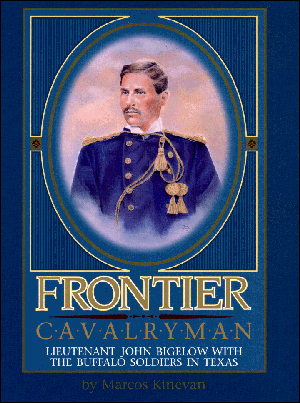
Marcos Kinevan's biography
of Lt. John Bigelow, Jr.
of the Tenth U.S. Cavalry
The Wonderful Country has a number of characters who serve in the Tenth U.S. Cavalry. The Tenth was famed for its African American "Buffalo" soldiers, and its exploits in fighting Indians, especially in Texas and then Arizona.

> See TSHA on Col. Benjamin H. Grierson

Less famous, but undeservedly so, is Lt. John Bigelow, Jr., who is the subject of a forthcoming paper I presented at last year's Center for Big Bend Studies Conference. His younger brother, Poultney Bigelow, who published his series of articles on trailing the Apaches, was a great friend of artist Frederic Remington who illustrated many of the articles. Their father, John Bigelow, was an accomplished editor (at one point editing the New York Times), he served as President Lincoln's ambassador to France, and had much to do with the founding of the Republican Party, the New York Public Library, the Panama Canal, and promoting Swedenborgianism. Bigelow, Sr also entertained literary celebrities including Charles Dickens and Oscar Wilde. My paper explores some of the family's rich and varied social and political connections, John Bigelow Jr's reports for Poultney's magazine, his role as a nexus between the Eastern establishment and the West, and his importance as a military intellectual who anticipated the profound changes to come in 20th century warfare.
> See my Notes on John Bigelow, Jr. and
> Further Notes on John Bigelow, Jr.


NOTES ON THE 1959 MOVIE "THE WONDERFUL COUNTRY" BASED ON THE NOVEL
... Reminds me of that old joke about the goats out browsing on a hill in Hollywood. They find the can with the reel of film, they kick it open, and they start munching... The one goat says to other, well, whaddya think? The other goat chews some more. "Eh," the goat says, "I liked the novel better."


One of the African American "Buffalo soldiers" is played by baseball star Satchel Paige. Tom Lea himself has a cameo as the barber, Peebles.


MORE ABOUT TOM LEA'S LIFE AND WORK

The go-to resource is the webpage for the Tom Lea Institute.

Tom Lea: An Oral History


Lea could be very self-depreciating. From Tom Lea: An Oral History:

"Writing is a kind of burden to me, which painting is not. I sweat and stew and fight painting, but I am not overwhelmed... by problems like I was with writing. I taught myself to write and never had any kind of a mentor or formal course... I taught myself to write by reading, reading good stuff."

On The Wonderful Country:

"...I wanted to do something that ad been on my mind since I was a kid: Write about this borderland and the people on both sides of the river."

"When traveling down in Mexico I never carried anything more than a little notebook because I was trying to train myself to hear rather than to see. I was trying so hard to be a good writer, you know... The hardest chapter in that book was where Martin goes with Joe Wakefield across the river in the springtime. I was trying to tell how much this fellow felt about both sides of the river. I remember I struggled and struggled for some way to express springtime and I settled it by saying, 'A mockingbird sang on a budded cottonwood' or something like that. I had to watch myself about using the big word. I always chose the shortest way if it could say exactly what I wanted."


NOTES ON CRAFT: SPECIFICITY

In my workshops I often discuss what it means to see as an artist and the importance of using specific details that appeal to the senses. Lea does this so beautifully. A few examples:

"A gust of wind sished sand against the one small windowpane." (p.16)
"They ate in the light of tallow dips, a dozen men in soggy leather, laughing and chewing, with the rain sounding on the roof, and cold drops leaking through." (p.250)
"Slowly, under the winking high stars, they came to where they saw beyond the paleness of the sand the darkness of the brush that lined the river, and they rode toward it. They worked across a dry flat of alkali white in the starlight, with the hooves scuffling the crust in the windless silence. " (p.306)


FURTHER MISC NOTES

From Tom Lea Month 2012, Nick Houser on Lea's Cabeza de Vaca picture


In my opinion, Lea's masterwork is his 1938 mural "The Pass of the North" which is in El Paso Historic Federal Courthouse Building.


NOTES ON HIS FAMILY

Lea's father was Tom Lea (1877-1945), who served as mayor of El Paso during the Mexican Revolution. (Alas, many Mexicans and Mexican Americans do not remember Mayor Lea fondly;  this is one reason why.)

A cousin was Homer Lea, an advisor to Sun Yat Sen.
> See Lawrence M. Kaplan's biography, Homer Lea: American Soldier of Fortune


> Your comments are always welcome. Write to me here.


Monday, June 18, 2018

WEST OF THE REVOLUTION: AN UNCOMMON HISTORY OF 1776 by Claudio Saunt

Get this book from
Seminary Co-op
amazon
et al
Of late American readers have been well served by a veritable cottage industry of works about the Roman Republic and Empire, and their respective falls, and various aspects thereof, and what lessons we, with our republic (or empire, as some would have it), purportedly at the precipice of analogous fiscal, ecological, military, social and/or  political Seneca Cliffs, might learn from them. History may not repeat itself any more than we can wade into the same river twice, but, of course, we can step into rivers that look more than a sight familiar. Sometimes a nicely behaved river—let’s dub it the Goth Swan—turns of a sudden into a drowning horror. Indeed, a close reading of Roman history does suggest, in blurriest outlines, some analogies with contemporary trends and conundrums. But there are perhaps more valuable insights to be parsed from our own little-known and, relatively speaking, recent history. CONTINUE READING AT LITERAL MAGAZINE


> Your comments are always welcome. Write to me here.


Monday, June 11, 2018

Virginia Tufte's ARTFUL SENTENCES: SYNTAX AS STYLE

As of this year, the second Monday of the month is dedicated to my workshop students and anyone else interested in creative writing.

While I increasingly rely on the Internet for reference—I’ll more likely type a word into my on-line dictionary or thesaurus than pull a wrist-breaker of an old tome off its shelf—there is still no substitute for a writer’s reference library—real books on a real shelf, at-hand. And among the most useful works in my own reference library is Virginia Tufte’s Artful Sentences: Syntax as Style. 
“... Tufte presents—and comments on—more than a thousand excellent sentences chosen from the works of authors in the twentieth and twenty-first centuries. The sentences come from an extensive search to identify some of the ways professional writers use the generous resources of the English language. 
“The book displays the sentences in fourteen chapters, each one organized around a syntactic concept—short sentences, noun phrases, verb phrases, appositives, parallelism, for example. It thus provides a systematic, comprehensive range of models for aspiring writers.”
But Artful Sentences is not only for aspiring writers. Having written more books than I’ll bother to count, I still find that an occasional review consistently yields inspirations.
Where, and for what effect, can I limber up my writing? Perhaps I need to work in shorter sentences. (p. 9) Bright little ones! 
Or perhaps, I could play a bit with what Tufte terms “Catalogs of modifiers” (p.100)-- basically, a bunch, a spew, an avalanche of adjectives. 
Or perhaps, I might try an adjective as an opener.” (p.160) Open doors, don’t they seem more inviting?


Artful Sentences elucidiates the immense range of possibilities we have in the English language to arrange our sentences, and within them, the sounds and rhythms of words, the better to sharpen and strengthen what we mean to say. And that, my dear writerly reader, is power.

P.S. You will find more recommended reading on my workshop page. 
> Your comments are always welcome. Write to me here.


Monday, May 28, 2018

Q & A with Yermiyahu Ahron Taub on PRODIGAL CHILDREN IN THE HOUSE OF G-D

Starting this year, every fourth Monday I run a Q & A with a fellow writer. This fourth Monday features Yermiyahu Ahron Taub, the author of Prodigal Children in the House of G-d: Stories (2018) and six books of poetry, including A Mouse Among Tottering Skyscrapers: Selected Yiddish Poems (2017). Preparing to Dance: New Yiddish songs, a CD of nine of his Yiddish poems set to music by Michał Gorczyński, was released in 2014. Taub was honored by the Museum of Jewish Heritage as one of New York’s best emerging Jewish artists and has been nominated four times for a Pushcart Prize and twice for a Best of the Net award. With Ellen Cassedy, he is the recipient of the 2012 Yiddish Book Center Translation Prize for Oedipus in Brooklyn and Other Stories by Blume Lempel (2016). His short stories have appeared in such publications as Hamilton Stone Review, Jewish Fiction .net, The Jewish Literary Journal, Jewrotica, Penshaft: New Yiddish Writing, and Second Hand Stories Podcast. 


Check out the Q & A  from 2017 with
Yermihayu Ahron Taub and his o-transator Ellen Cassedy
about Blume Lempel and Oedipus in Brooklyn
C.M. MAYO: You are co-translator (with Ellen Cassedy) from the Yiddish of Blume Lempel's extraordinary short stories, Oedipus in Brooklyn. Would you say that Lempel's work has been an influence on your own fiction? Can you talk a bit about some of your influences, and your favorite writers?  

[>>CONTINUE READING THIS POST ON THE NEW SITE, MADAM-MAYO.COM]
YERMIYAHU AHRON TAUB: Blume Lempel is certainly a source of personal inspiration, and working with Ellen Cassedy on that project was and continues to be a great joy. Despite suffering enormous familial loss in the Holocaust and years of creative block, Lempel built a career as a Yiddish writer with single-minded focus and commitment. She created an authorial voice that was uniquely her own and a prose rich in poetry, experimentation in time and voice, and empathy. She looked at characters at the margins of society and at themes still considered taboo, including abortion, prostitution, and incest. I was drawn to Lempel's work for all of these reasons and in researching her autobiography, came to be inspired also by the example of her courage in life and art. Our work overlaps somewhat in our interest in life at the margins and blurring the line between poetry and prose, although I think much of Lempel's work is more firmly anchored than mine in the realm of the experimental and avant-garde. I do see Lempel as a kindred literary spirit.  

I have been reading voraciously and widely since childhood. It's difficult to pinpoint specific literary influences. I prefer to think of texts whose effects remain with me. Even if I don't recall particular plots, the authors' themes and concerns, and overall sensibilities remain. I am interested in writers who take risks, who go against the grain, who can create a marriage of emotional impact and beauty of language, who write with psychological acuity and care. 

A partial list of favorite English-language fictional texts, in alphabetical order of author's last name, include:  


Julia Alvarez, How the Garcia Girls Lost Their Accents  
Michelle Cliff, Abeng
Marian Engel, Bear  
Janet Hobhouse, The Furies 
F.M. Mayor, The Rector's Daughter  
Elizabeth McCracken, The Giant's House: a Romance  
Gloria Naylor, The Women of Brewster Place  
Joyce Carol Oates, Where is Here?  
James Purdy, 69: Dream Palace and Other Stories  
Jean Rhys, Wide Sargasso Sea  
Marilynne Robinson, Gilead, Home, and Lila  
Sinclair Ross, As For Me and My House  
Elizabeth Taylor, Angel and Mrs. Palfrey at the Claremont  
Edith Wharton, The House of Mirth  

If we include non-fiction, poetry, and Yiddish literature and world literature in translation, there would be many more titles to add.  

C.M. MAYO: You have been a consistently productive writer and poet for many years. How has the digital revolution affected your writing? Specifically, has it become more challenging to stay focused with the siren calls of email, texting, blogs, online newspapers and magazines, Facebook, Twitter, and such? If so, do you have some tips and tricks you might be able to share? 

YERMIYAHU AHRON TAUB: The digital revolution has helped bring about a dynamic international literary culture. Poems and stories can now be read by anyone with computer access. Blogs such as yours also support the work of writers and connect writers and readers. Before appearing in book form, much of my work has appeared in online publications. In the digital age, it is more affordable to publish literary 'zines, although maintaining the availability of defunct journals remains an issue of concern for literary publishers, writers, and readers. Facebook is useful for sending out announcements of new work and seeing what colleagues and friends have been doing. I also enjoy the travel, food, and family photos that people post! I started on Facebook fairly recently. I thought it would take more of my time that it actually has. I am not on Twitter or other social media. 

There's only a limited amount of time in the day. I like to set aside time for daily translation, reading, and/or writing or writing-related business, as well.  The proliferation of media in the digital age offers tempting distractions from writing. There are now so many offerings in television and film, many of them quite literary and demanding extensive viewing time. 

Still, I always return to the written word. And I prefer to read in hard copy. Nothing has replaced words on a paper—the joy that comes from concentration on those words, turning the page, the touch of paper, the heft of a book in one's hand or one's lap. The poems "Eavesdropping" and "Luddite's Exhortation" in my fourth collection Prayers of a Heretic explore the pleasures—cerebral, sensual, and otherwise—of books and reading from books. The key to productivity is tuning out all of the distractions to draw on the creativity that emerges from focus and quiet, or perhaps more aptly put, quietude. One can be sitting in a noisy cafe and still be in a place of internal quiet. 

But, of course, there are many ways to live and work as a writer. Find what works for you and honor that process.  

C.M. MAYO: Are you in a writing group? If so, can you talk about the members, the process, and the value for you?  

YERMIYAHU AHRON TAUB: When I lived in New York, I was in the Yugntruf Yiddish writers' circle for many years. Attendees brought in a poem or a story and shared it with the group. It was a great way for me to get feedback on my Yiddish writing and to encounter new Yiddish creativity. That group continues to meet.  I have attended two sessions of a poetry group here in Washington, D.C. I'm not sure if that qualifies as being "in a writing group." Here too, folks distribute the poems, read it aloud, and then provide comments. The feedback was quite rigorous and helpful, and I enjoyed the gatherings. However, I've only attended two sessions since my recent focus has been on writing prose and on translating from the Yiddish.  

C.M. MAYO: Did you experience any blocks while writing these stories, and if so, how did you break through them?  

amazon.com

YERMIYAHU AHRON TAUB: Fortunately, I did not experience writer's block while writing these stories. As I note in the book, I wrote Prodigal Children in the House of G-d while on an artist's residency at The Writers' Colony at Dairy Hollow (Eureka Springs, Arkansas). Having three weeks to concentrate solely on writing enabled my turn from poetry to fiction. TWCDH was a magical experience — a great studio, friendly staff and writers in residence, and the ideal setting that combined natural beauty and a charming, historical small town. During the afternoons, I took walks and worked through ideas for the writing I was doing in the studio. Sometimes, I took walks with other writers in residence. 

C.M. MAYO: Back to a digital question At what point, if any, were you working on paper for these stories? Was working on paper necessary for you, or problematic?  

YERMIYAHU AHRON TAUB: My writing life as an adult has largely been conducted on the computer. Of course, the digital revolution has made it easier to submit work to literary magazines. Instead of having to print out hard copies, write and include a self-addressed stamped envelope, and go to the mailbox or post office, one can now submit work electronically. Writing on the computer also allows for extensive revision.  In my childhood and youth, I wrote by hand. In college, I sometimes submitted papers typed on a typewriter. So I remember well the challenges in the revision process back then. 

C.M. MAYO: Do you keep in active touch with your readers? If so, do you prefer hearing from them by email, sending a newsletter, a conversation via social media, some combination, or snail mail?  

YERMIYAHU AHRON TAUB: I welcome feedback from readers. I prefer e-mail over other forms of communication. I sometimes go for long periods of time without checking Facebook. I rarely use snail mail. I try to answer all letters. Giving readings, particularly ones that include a Q & A, is another great way to connect with readers. 

# # # # # # # #

> Your comments are always welcome. Write to me here.


# # # # # # # #

COMMENT:
M.L. recommends checking out Yermihayu Ahron Taub's page on Beltway Quarterly.


Monday, May 21, 2018

Cyberflanerie: Noteworthy Blogs of Late & More

Holding the Light: Pat Dubrava's luminous essay, Not Even the Trees.

Rose Mary Salum, Mexican poet, novelist, essayist and editor of Literal ponders #MeToo.

Mr. Money Mustache reveals his breakfast, among other things.

Low Tech Magazine:  Ditch the Batteries and History and Future of the Compressed Air Economy.

Granola Shotgun on Thousand Oaks. I was struck by the comment by host Johnny (in reply to Here in Van Nuys):
"I’ve come to the conclusion that fretting over aesthetics (like the abundant use of synthetic grass lawns and Lee Press-On faux facades) isn’t a productive use of my energies. Neither is kvetching about regulations or other people’s attitudes about… anything. Let it go.
"Focus on the underlying structural dynamics. Some places are well suited to change and will ride out future dynamics better than most. Others are destined to decline rapidly under the best of circumstances. Thousand Oaks will endure for quite some time because the people who live there have political authority and money to buffer themselves fro quite a lot. It’s a good place. It’s just not my place."
Here in Van Nuys on The Parking Police. This is a blog I've been following regularly. I am seeing some of these very same issues in northern California, where I have family, and as a novelist-sociologist (all novelists are sociologists) and ex-economist (yes, I used to be an economist) I find them fascinating. It's a grim portrait of place at times. But such is our societal and fiscal trajectory. And I want to get my mind around it.

Black Liszt: David Black talks about Innovation Stories in his new book.

Typewriter Revolution: I am honored that Richard Polt dedicates the poem "Vanilla" to Yours Truly. (I am back to typing on a typewriter again, now that I have another Hermes, an Hermes Baby, circa 1960s.) I got the dedication because I supplied the word as a prompt. Funny, I thought of "vanilla" as exotic and spicy-- I forgot, having lived in Mexico so many years, where vanilla is a sharply delicious flavor, and vanilla icecream packs some zing, its connotations of blah north of the border. (P.S. With his typewriter advocacy, Polt, a noted professor of philosophy and expert on Heidegger, is doing something far more interesting than it might appear at first glance.)

Cal Newport shares his morning routine with Business Insider. His blog is here.

The Archdruid has suggested that his readers try a secret experiment.

YEA, VERILY, MOOOOORE!

Podcasts:

David J. Silverman gives an interview to Ben Franklin's World podcast about Thundersticks. This is a brilliant, important book.


Magazines:

A signal of a cultural tide turning: Rebecca Solnit's essay in this month's issue of Harper's, Driven to Distraction.

Fodder for another blog post: I recently took out a batch of print magazine subscriptions, so as to spend less time on the iPad. So far so good-- and if not for my Harper's subscription, I would have missed Solnit's essay. But I treasure the blogosphere. As a writer I love the freedom and speed; as a reader, I relish the adventures with unique, unfiltered voices and their sometimes fabulous, sometimes squirrely, othertimes, whoa, too-way-out-for-prime-time ideas and information.

>>Your comments are always welcome. Write to me here.


Monday, May 14, 2018

Blast Past Easy: A Permutation Exercise with Clichés

By C.M. Mayo www.cmmayo.com

As of this year, the second Monday of the month is dedicated to my workshop students and anyone else interested in creative writing.

YE ARCHAEOLOGICAL FIND
Yes, this was on my bookshelf and
yes, I actually used to consult it
I've previously posted on my favorite exercises for a fast-acting manuscript Rx, what I call "emulation" or "permutation" exercises, here. (Which one is it, emulation or permutation? Depends. That would be another post.)

The basic idea is to take a phrase or perhaps as many as a few sentences from another writer's work or from your own manuscript, and play with it in some predetermined way. Sometimes the exercise might prompt a new piece; othertimes it might give you just what you need to brighten up the blah or smooth a rough patch in a draft. Moreover, for my wampum, permutation exercises beat crossword puzzles by a Texas section. (Yowie, that was an orangutang's tea party of imagery!)

[>>CONTINUE READING THIS POST AT MADAM-MAYO.COM]

Yes, I am being silly. To play, you have to be willing to be silly! Tell your ego to just take a long cool breath. You, dear writerly reader, do not have to use the results of your writing exercises in your manuscript, never mind show them to anyone else.

Simply, for any given permutation exercise, come up with a bunch of things! Maybe elegant, maybe dorky. Maybe even dorksterly dorkikins dorky. Then circle the one or two results that, for whatever reason, strike your fancy and/or seem apt for your purposes.

In my experience, and that of many of my writing students, doing these exercises is a tiny investment for a mega-payoff. The more often you do these little exercises, the easier they get, and this ease will greatly serve you in your endeavors to write, and in particular, to write more vividly. You will also get practice in generating material you are able to, la de da, discard. And discarding unworthy bits and pieces of a draft, and even whole novels, without attachment, that's a vital skill for a writer, too.

"IT'S LIKE DEJA VU ALL OVER AGAIN"

There are as many permutation exercises as you can dream up. This one, what I call "Blast Past Easy," plays with cliché.

How can you spot a cliché? If a phrase sounds familiar and/ or it came to you too easily, it's probably a cliché.

What's wrong with cliché? For more discerning readers, whom presumably you would want to have, cliché signals a lack of originality and/or naiveté and/or sloppiness. In sum: mediocrity. There are exceptions-- for example, a fictional character or the subject of biography might use cliché (and if they do, that tells us somehing about them, does it not?) And some essayists use cliché for comic effect. (I'll be posting about intentional diction drops anon.)

"Like deja vu all over again"-- well, you can debate me, but I'm going to call that a cliché, except  as used by Yogi Berra, because he's the one who came up with it.

Here are a few clichés I happened upon in recent weeks' reading, and my permutations-- four each. If you feel so moved, a good exercise could be to add more permutations of your own.

"Talk does not boil the rice"
Talk does not shampoo the pooch
Talk does not slice the pepperoni
Talk does not iron the shirts
Talk does not roast the turkey
(You might try a permutation of the noun, "talk," e.g., art; violin playing; texting

"Shoveling smoke"
Shoveling soap bubbles
Shoveling Koolaid
Shoveling fog
Shoveling thunder
Shoveling granola
Shoveling marshmallows

"Bet you dollars for donuts"
Bet you deutschmarks for Dingdongs
Bet you dinars for dinos
Bet you dollars for diddlysquat
Bet you pounds for peanuts

(Part of what makes "dollars for donuts" such an appealing cliché is the alliteration, that is, the repeating "d"s of "dollars" and "donuts." You might try varying the sound, e.g., silver for Skittles, or, pesos for pips, etc.)

"Let the cat out of the bag"
Let the cockroach out of the bag
Let the bedbug out of the backpack
Let the tarantula out of the pickle jar
Let the troll out of the compost pile
(Another permutation could be to switch the verb, e.g, Put the cat in the bag; stuff the cat in the bag; drown the cat in the bag; swing the cat in the bag, etc.)

"The bee's knees"
The snail's tail
The donkey's ankle
The sloth's toenail (doesn't rhyme but, oh well, I like it)
The kitten's mittens (is that a cliché?)

"A fish out of water"
A mole out of its hole
A horse out of its pasture
A sheep out of its herd
A credit card nowhere near a department store

# # #

P.S. Visit my workshop page here. For more exercises, help yourself to "Giant Golden Buddha & 364 More Free Five Minute Writing Exercises."

Today's exercise is

May 14 "Barrel, Mirror, Telephone"
In three sentences or less describe the barrel. In three sentences or less describe the mirror. Where is the telephone? Describe what happens.

> Your comments are always welcome. Write to me here.


Monday, May 07, 2018

Jeffrey Mishlove's New Video Series "InPresence"

Highly recommended: Psychologist Jeffrey Mishlove's new series of short inspiring talks, "InPresence," on his YouTube channel, New Thinking Allowed. 

InPresence  0001:


InPresence 0002:


InPresence 0003:


To date Mishlove has posted 70 InPresence videos.You can find these and his many interviews on the "playlists" page for his YouTube channel.

(I am honored to say that a couple of years ago, for New Thinking Allowed, Mishlove interviewed me about my book, Metaphysical Odyssey into the Mexican Revolution: Francisco I. Madero and His Secret Book, Spiritist Manual.)

> Your comments are always welcome. Write to me here.


Monday, April 30, 2018

Notes on Wolfgang Schivelbusch's THE RAILWAY JOURNEY: THE INDUSTRIALIZATION OF TIME AND SPACE IN THE NINETEENTH CENTURY

Get this book at
The Seminary Co-op
By C.M. Mayo www.cmmayo.com

"Systems analysis must become cultural analysis, and in this historians may be helpful."-- Lynn White, Jr. 


Drive into Far West Texas and before you can say "pass the Snickers" you'll spy the railroad tracks, which more often than not run, seemingly infinite sinuous ribbons, parallel to the highway. Travel for a spell and you'll pass or, if at a crossing, be passed by a freight train, always an impressive experience. All of which is to say, railroads are an inescapable part of Far West Texas scenery and history, and so, for my book in-progress on that region, I have been doing my homework.

[>>CONTINUE READING THIS POST AT WWW.MADAM-MAYO.COM]

Of late: The Railway Journey: The Industrialization of Time and Space in the Nineteenth Century by Wolfgang Schivelbusch, a German historian and scholar of cultural studies. Originally published as Geschichte der Eisenbahnreise, the English translation came out in 1979; I read the 2014 edition with a new preface, "World Machines: The Steam Engine, the Railway, and the Computer," in which  Schivelbusch asks,
"Could it be that the railway, the accelerator of the Industrial Revolution, and the computer occupy different points along / on the same trajectory of machine evolution?"

In recent weeks, this question of machine evolution, to my surprise, has begun to interest me intensely.

At first I had thought of this book I am writing about Far West Texas as a doppelgänger to my 2002 memoir of Mexico's Baja California peninsula, Miraculous Air, for the ecosystems and early exploration and mission histories of these two regions have many parallels. There are indeed many parallels, however, to start with, the literature on Far West Texas is exponentially greater and-- more to the point-- since the time I was traveling in Baja California, the experience of traveling itself has been radically transformed by the Digital Revolution. My sense of this is a compression of time and a curious elasticity of space; of oftentimes disquieting and othertimes most welcome transparency; and that constant pull to the little screens that, so it would seem, we all feel these days, whenever, wherever.

In The Railway Journey, Schivelbusch opens with a detailed discussion of the history of the steam engine.

"Next to wood, water and wind power were the main energy sources of pre-industrial economic life. The Industrial Revolution, generally seem as having begun in the the last third of the eighteenth century, was a complex process of denaturalization... Iron became the new industrial building material, coal the new combustible. In the steam engine, the prime mover of industry, these two combined to produce energy in theoretically unlimited amounts."

The "decisive step" for the development of the steam engine-- and ultimately the railroads-- was the introduction of rotary motion, "a kind of mechanization of the mill race." In other words, transforming the up-and-down movement of the steam-driven piston to the driving wheel.

In his new 2014 preface, however, Schivelbusch writes: "It took me forty years and the Digital Revolution to realize that I had missed the more important point of the invention preceding it." In other words, the technological Crossing of the Rubicon, as it were, was "placing a piston in a cylinder and applying the pressure of steam... [I]t did not transfer an existing form but forced a new form of power out of combustible matter." Moreover, "the piston's up-and-down movement was no longer the analogue of any form of movement found in nature but possessed a binary-digital logic all its own."


Watch a demonstration of a piston (in this example, powered by an electric motor):


Most histories of the computer's binary-digital logic that I am familiar with focus on English mathematician George Boole's An Investigation into the Laws of Thought (1854)-- the concept of binary logic. Schivelbusch's is a wondrously powerful insight. 


THE MACHINE ENSEMBLE

In his second chapter, "The Machine Ensemble," Schivelbusch explores the ways the development of the railways was experienced as "denaturalization and densensualization." With cuttings, embankments, and tunnels"the railroad was constructed straight across the terrain, as if drawn with a ruler." Now "the traveler perceived the landscape as it was filtered through the machine ensemble."

And what is the machine ensemble? "[W]heel and rail, railroad and carriage, expanded into a unified railway system... one great machine covering the land."


RAILROAD SPACE

With the railroad, argues Schivelbusch, "space was both diminished and expanded." Things moved across space faster, and simultaneously, more space could be accessed. "What was experienced as being annihilated was the traditional space-time coninuum which characterized the old transport technology."

Schivelbusch quotes the German poet Heinrich Heine, writing in 1843:
Heinrich Heine, protosurrealist
"What changes must now occur, in our way of looking at things, in our notions! Even the elementary concepts of time and space have begun to vacillate. Space is killed by the railways, and we are left with time lone... Now you can travel to Orléans in four and a half hours, and it takes no longer to get to Rouen. Just imagine what will happen when the lines to Belgium and Germany are completed and connected up with their railways! I feel as if the mountains and forests of all countries were advancing on Paris. Even now, I can smell the linden trees; the North Sea's breakers are rolling against my door."

Sniffed Victorian-era English art critic John Ruskin:
"Modern traveling is not traveling at all; it is merely being sent to a place, and very little different from being a parcel."

(I quail to imagine what might have been Ruskin's reaction to a TSA line. We airline travelers have been demoted from parcel to cattle...)


PANORAMIC TRAVEL

For me, having spent so many hours driving through the vast spaces of Far West Texas, the fourth chapter, "Panoramic Travel," was the most engaging. The opening epigraph is from Emerson's Journals: "Dreamlike traveling on the railroad." In a car, as in a railway compartment, we are enclosed from the weather behind windows, and by a roof and a floor. We rest our bodies in an upholstered seat. Beyond the window, things sail by silently, inexorably, scentlessly: hills, fences, a gas station-- it becomes a blur.

Travel by railroad induced "panoramic perception." Schivelbusch:

"Panoramic perception, in contrast to traditional perception, no longer belonged to the same space as the perceived objects: the traveler saw the objects, landscapes, etc. through the apparatus which moved him through the world. That machine and the motion it created became integrated into his viual perception: thus he could only see things in motion. That mobility of vision-- for a traditionally oriented sensorium, such as Ruskin's-- became a prerequisite for the 'normality' of panoramic vision. This vision no longe experiences evanescence: evanescent reality had become the new reality." (p.64)

Because this can be deadly boring, and necesitated being in close quarters with fellow travelers of, shall we say, possibly inconvenient social connections, bougeois train travelers took up reading. Schivelbusch:
"Reading while traveling became almost obligatory.The dissolution of reality and its resurrection as panorama thus became agents for the total emancipation from the traversed landscape: the traveler's gaze could then move into an imaginary surrogate landscape, that of his book." (p. 64)*

But back to computers. I am beginning, with fraying patience, to think of ours as the Age of Phubbing Smombies. To walk the aisle of a railway passenger car or an airplane  is to catch the soundless glow of dozens of little screens... the overwhelming majority not of text but of flashing images of murders, faces, scantily clad women, roaring dinosaurs, cars and other objects hurling off cliffs (what is it with all the cliffs?).. and cartoons of the same... In sum, a mesmerizing mishmash of imagery.


AMERICAN VS EUROPEAN RAILROADS

In the 19th century the "great machine" of the railway ensemble spread across the land in both Europe  and the North American continent, but, as Schivelbusch details, there were fundamental differences in the pattern and nature of that machine. Europe was already densely populated and richly networked by highways and roads; "in America, the railroad served to open up, for the first time, vast regions of previously unsettled winderness."* In other words, to quote Schivelbusch quoting von Weber, "In Europe, the railroad facilitates traffic; in America, it creates it."

*Quibble: Important regions of America's interior were not in fact a wholly "unsettled wilderness" until after the cascading demographic collapses,  and later Indian removals, and the Indian Wars. There were well-established trails and trade routes throughout the continent, many going back many hundreds of years. But yes, compared to Europe, the road networks in Amreica were thin and poor and the vast desert expanses and the Great Plains were terrible, as many memoirs attest, to traverse by horse-drawn vehicles. 
And while Europe's industrial revolution focused on manufacturing, primarily textiles, in America it was about agriculture (cotton, tobacco) and transport. In the early 19th century, what American industry had in the way of machines was, writes Schivelbusch, "river steamboats, railroad trains, sawmills, harvesting combines."

By the 19th century the string of older cities of the North Atlantic coast-- Boston down to Washington DC-- were linked by well-established highways, however, the rest of the continent had more primitive roads, oftentimes what amounted to footpaths and, above all, waterways: The Mississippi, the Missouri, the Ohio, the Hudson, various canals, and the Great Lakes. "Thus passenger travel used these waterways in the absence of highways... One traveled by water whenever possible."

Unsurprisingly, the American railway compartment took on the distinctive character of the American riverboat cabin. These tended to be broad open rooms, more comfortable for traveling long distances. European railroad compartments took their template from the stagecoach, a cozier space.

Schivelbuch argues that in American culture the railroad was closely linked with the steamer both because it was these were the first and second mechanized means of transportation and because so much of the interior landcape-- the Great Plains--was described by travelers as kind of vast ocean. (Indeed it was, in an eon past, the bottom of an ocean.)

The path of the railroad tracks differed as well: American tracks tended to curve where European tracks would be straight. As Schivelbusch points out, this reflected differences in labor and land costs. In America, land was cheap and labor expensive. In Europe then "it paid to construct tunnels, embankments and cuttings in order to make the rails proceed in a straight line, at a minimum of land cost."

Ah, so that explains the sinuosity of those Far West Texas rails.


INDUSTRIALIZED CONSCIOUSNESS

"new consciousness of time and space based on train schedules and the novel activity of reading while traveling" (p.160)

Re: The reconsideration of the concept of shock in the 19th century. Schivelbusch:

"The railroad related to the coach and horses as the modern mass army relates to the medieval army of knights (and as manufacture and industry do to craftmanship.)" (p.159)

 Re: A "sinister aspect". Schivelbusch:

"...it had become possible to travel in something that seemed like an enormous grenade." (p.160)
"The train passenger of the later nineteenth century who sat reading his book thus had a thicker layer of that skin than the earlier traveler, who coud not even think about reading because the journey still was, for him, a space-time adventure that engaged his entire sensorium." (p.165)

(Thicker layer of skin!! Just turn on TV news!! The commercials!! In our day, we've all grown callouses on top of rhino hide.)


HAUSSMANN'S REDO OF PARIS AND A NEW CONSCIOUSNESS FOR A NEW CITYSCAPE

Schivelbusch covers Haussmann's remodeling of Paris in detail in chapter 12, "Tracks in the City."

"The streets Haussmann created served only traffic, a fact that distinguished them from the medieval streets an lanes that they destroyed, whose function was not so much to serve traffic as to be a forum for neighborhood life; it also distinguihsed them from the boulevards and avenues of the Baroque, who linearity and width was designed more for pomp and ceremony han for mere traffic." (p. 183)
"The broad, tree-lined streets were seen as providers of light and air, creating sanitary conditions in both a physiological and a political sense-- the latter favorable to the rule of Napoleon III." (p. 186)


MORE ABOUT PANORAMIC PERCEPTION

The final chapter, "Circulation," looks at the consequences of the changes in transportation for retail, specifically, the development of department stores.

"As Haussmann's traffic arteries were connected to the rail network by means of the railway stations,and thus to all traffic in its entirety, the new department stores, in turn, were connected to the new intra-urban arteries and their traffic. The Grands Magasins that arose during the second half of the nineteenth century were concentrated on the boulevards that supplied them with goods and customers." (p.188)
While traveling on the train put an end to conversation, so the department store put an end to haggling, for now there were price tags.

Department stores encouraged panoramic perception.

"There had to be noise, commotion, life everywhere... The customer was kept in motion; he traveled through the department store as a train passenger traveled through the landscape. In their totality, the goods impressed him as an ensemble of objects and price tags fused into a pointillistic overall view..."(p. 191)

The sources of parnoramic perception were at once speed and "the commodity character of objects."(p. 193)


THE CIRCULATION CONCEPT IN THE 19th CENTURY

"... whatever was part of circulation was regarded as healthy, progressive, constructive; all that was detached from circulation, on the other hand, appeared diseased, medieval, subversive, threatening."
(p. 195)


CIAO, GRAND TOUR

Re: The Grand Tour, "an essential part of ... education before the industrialization of travel." The world was experienced in its original spatio-temporality... His education consisted of his assimilation of the spatial individuality of the places visited, by means of an effort that was both physical and intellectual" (p. 197)

(At this thought, of the industrialization of travel, I had an evil little chuckle recalling Mrs Pofrock in Henry James' The Ambassadors.)

So:
"The railroad, the destroyer of experiential space and time, thus also destroyed the educational experience of the Grand Tour... the places visited by the traveler became increasingly similar to the commodities that were part of the same circulation system. For the twentieth-century tourist, the world has become one huge department store of countrysides and cities" (p. 197)

I would venture that a more apt analogy would now be "menu of venues for digitally realized self-presentation" -- translation from the Noodathipious Flooflemoofle: "selfies." I hear most everyone shops online these days.


 # #


FURTHER TIDBITTY THOUGHTOID

A curious analogy occured to me, that just as the automobile allowed for more agency for a traveler vis-a-vis the railroad, so the tablets and smartphones allow more agency than the television for the consumer of entertainment.


FURTHER TECHNOLOGY CYBERFLANERIE

Lynn White's 1973 address to the American Historical Society
Both charming and profound.

Society for the History of Technology's List of Classic Works in the History of Technology
Note: One book that should be on that list and for some unfathomable reason is not:
Donald R. Hill's Islamic Science and Engineering (Edinburgh University Press, 1993)
Speaking of which, why isn't Schivelbusch?! Let's call it a handy, albeit embryonic, list.

See also SHOT's Basic Bibliography of Works in the Field

# # #

> Your comments are always welcome. Write to me here.